How to Cite a Research Paper: APA, MLA, Chicago, and IEEE Examples
Learn how to cite a research paper accurately across APA 7th, MLA 9th, Chicago 18th, and IEEE styles. Includes multi-style comparison tables, unified examples, and checklists.

Citing academic research accurately is the cornerstone of scholarly integrity, scientific credibility, and intellectual transparency. Whenever you write an academic essay, thesis proposal, literature review, or experimental journal article, your citations fulfill a dual purpose: they give due credit to the intellectual originators of ideas, and they provide an auditable bibliographic trail allowing readers to verify your claims, evaluate your data, and explore related research.
Navigating academic citation can feel daunting because major disciplines adhere to distinct style conventions. Psychology and social sciences follow APA style; literature and humanities favor MLA style; history and publishing rely on Chicago style; and engineering, computer science, and technical fields mandate IEEE numeric formatting. This comprehensive guide breaks down the mechanics of citing research papers across all four major systems. We explore the essential bibliographic metadata required for any source, compare style rules side by side, demonstrate how a single illustrative fictional paper is cited across all five formatting paradigms, review common pitfalls such as AI citation hallucinations, and provide an actionable pre-submission citation checklist.
1. What Does It Mean to Cite a Research Paper?
To cite a research paper means to explicitly acknowledge the source of information, ideas, empirical data, or methodology integrated into your manuscript. Academic citation is not a bureaucratic hurdle; it is an active contribution to the scholarly conversation.
Proper citation fulfills three vital academic functions:
- Intellectual Attribution: It respects copyright and intellectual property by acknowledging the scholars whose research informed your work.
- Evidence Traceability: It enables instructors, peer reviewers, and fellow researchers to verify whether the cited evidence actually supports the claim you made.
- Contextualizing Scientific Progress: It establishes the intellectual genealogy of your research question, demonstrating which theories are established and which remain open to debate.
Every citation system operates on a paired structure: a concise in-text citation placed adjacent to the referenced material, and a comprehensive bibliographic reference entry located at the end of the manuscript.
2. Essential Metadata Required to Cite Any Paper
Before formatting a citation in any style, you must extract eight fundamental pieces of bibliographic metadata from the published article:
- Author Names: Full surnames and given names or initials of all contributing authors, recorded in the exact order listed on the article title page.
- Publication Date: The year of publication, accompanied by the month or season if required for periodicals or preprints.
- Article Title: The complete title and subtitle of the research article, maintaining exact capitalization rules specified by your target style.
- Journal or Conference Name: The official name of the publication venue (e.g., Journal of Cognitive Neuroscience or IEEE Transactions on Software Engineering).
- Volume and Issue Numbers: The periodical volume number and issue number (or month designation) identifying the specific release.
- Page Range or Electronic Article Identifier: The start and end page numbers (e.g., 142-158) or the unique electronic article number (e.g., e024192) used by modern open-access digital repositories.
- Digital Object Identifier (DOI): The permanent, standardized alpha-numeric identifier resolving directly to the publisher's digital record (preferred in format
https://doi.org/10.xxxx/xxxx). - URL and Access Date: Stable publisher URL when a DOI is unavailable, alongside access dates where required for evolving digital documents.
3. APA Style (7th Edition) Citation Rules
The American Psychological Association (APA 7th edition) style is the standard format for psychology, education, social sciences, nursing, and business disciplines. APA uses an Author-Date citation mechanism.
APA In-Text Citations
APA in-text citations can be parenthetical or narrative:
- Parenthetical Citation: Both author and year appear in parentheses at the end of the clause:
(Vance, 2024)or(Vance & Holloway, 2024). - Narrative Citation: The author's surname is woven into the sentence structure with the year in parentheses immediately following:
Vance (2024) argued that...orVance and Holloway (2024) demonstrated.... - Three or More Authors: Abbreviate immediately to the first author followed by 'et al.' in both parenthetical and narrative citations:
(Vance et al., 2024)orVance et al. (2024). - Direct Quotations: Always include the page number:
(Vance et al., 2024, p. 251).
APA Reference List Structure
APA reference list entries feature a hanging indent of 0.5 inches, sentence case for article titles, and italicized journal titles and volume numbers:
Author, A. A., & Author, B. B. (Year). Title of the article in sentence case. Title of Journal in Title Case, Volume(Issue), StartPage-EndPage. https://doi.org/10.xxxx/xxxx
4. MLA Style (9th Edition) Citation Rules
The Modern Language Association (MLA 9th edition) style is the dominant standard in English studies, literature, art history, modern languages, and cultural studies. MLA employs an Author-Page system.
MLA In-Text Citations
- Parenthetical Citation: Place author surname and page number without a comma:
(Vance 251). - Two Authors: Connect with 'and':
(Vance and Holloway 251). - Three or More Authors: Use the first author followed by 'et al.':
(Vance et al. 251). - Narrative Citation: Include author name in sentence, placing only page number in parentheses:
Vance argues that metacognitive monitoring is essential (251).
MLA Works Cited Structure
MLA utilizes the 'container' model, putting article titles in quotation marks with title-case capitalization, italicizing the journal container, and spelling out 'vol.' and 'no.':
Author, First Name, and Second Author. "Title of the Article in Quotation Marks." Journal Title in Italics, vol. 16, no. 3, 2024, pp. 245-62. Database or Repository, https://doi.org/10.xxxx/xxxx.
5. Chicago Style (18th Edition): Notes-Bib versus Author-Date
The Chicago Manual of Style (CMOS 18th edition) provides two distinct documentation systems. Choosing the correct one depends strictly on your academic department:
1. Notes and Bibliography (Humanities & History)
This system uses superscript numerical markers within the text keyed to footnotes or endnotes, supplemented by a final bibliography:
- In-Text Marker: Superscript number placed after punctuation:
...as Vance observed.1 - Footnote (Full Note):
1. Elena M. Vance, Marcus T. Holloway, and Sophia R. Sterling, "Neural Substrates of Metacognitive Monitoring," Journal of Cognitive Computation 16, no. 3 (2024): 251, https://doi.org/10.xxxx/xxxx. - Footnote (Shortened Note):
2. Vance, Holloway, and Sterling, "Neural Substrates," 254. - Bibliography Entry: Authors listed surname-first, separated by periods:
Vance, Elena M., Marcus T. Holloway, and Sophia R. Sterling. "Neural Substrates of Metacognitive Monitoring." Journal of Cognitive Computation 16, no. 3 (2024): 245-262. https://doi.org/10.xxxx/xxxx.
2. Author-Date (Physical, Natural, & Social Sciences)
Similar to APA, this system uses in-text parenthetical citations without commas between author and year: (Vance, Holloway, and Sterling 2024, 251), paired with an alphabetical reference list at the end of the manuscript.
6. IEEE Style Citation Rules and Numbering
The Institute of Electrical and Electronics Engineers (IEEE) style is standard across computer science, electrical engineering, telecommunications, robotics, and biomedical devices. IEEE uses a Numeric citation sequence.
IEEE In-Text Citations
- Citation Marker: Bracketed numbers assigned in order of appearance:
[1]. - Subsequent Mentions: Always reuse the originally assigned number:
As discussed in [1], earlier architectures exhibited latency... - Multiple Citations: Separate individual numbers inside brackets:
[1], [3], [5]-[7]. - Grammatical Usage: The bracketed number acts as a noun:
As demonstrated by Vance et al. in [1]...or simplyAs demonstrated in [1]....
IEEE Reference List Structure
The IEEE reference list is sorted numerically rather than alphabetically, matching the order in which citations appear in the text. Author initials precede surnames:
[1] E. M. Vance, M. T. Holloway, and S. R. Sterling, "Neural substrates of metacognitive monitoring in autonomous decision systems," J. Cogn. Comput., vol. 16, no. 3, pp. 245-262, Sep. 2024, doi: 10.xxxx/xxxx.
7. Comprehensive Cross-Style Comparison Table
Study this comparative reference table to see how fundamental citation dimensions differ across the major academic systems:
| Style | In-Text Format | Article Title Formatting | Journal Title Formatting | Bibliography Order | Primary Academic Disciplines |
|---|---|---|---|---|---|
| APA (7th) | Author-Date (Vance, 2024, p. 251) |
Sentence case, no quotation marks | Italics, Title Case with volume in italics | Alphabetical by first author's surname | Psychology, Social Sciences, Education, Business |
| MLA (9th) | Author-Page (Vance 251) |
Title Case in quotation marks | Italics, Title Case followed by vol./no. | Alphabetical by first author's surname | Literature, Humanities, Modern Languages, Art |
| Chicago Notes | Superscript number ...claim.1 |
Title Case in quotation marks | Italics, Title Case followed by volume/issue | Alphabetical by first author's surname | History, Fine Arts, Philosophy, Publishing |
| Chicago Author-Date | Author-Date (Vance 2024, 251) |
Title Case in quotation marks | Italics, Title Case followed by volume/issue | Alphabetical by first author's surname | Physical and Natural Sciences, Anthropology |
| IEEE | Bracketed Number [1] |
Sentence case in quotation marks | Italics, standard abbreviated journal title | Numerical by order of appearance in paper | Electrical Engineering, Computer Science, Robotics |
8. One Fictional Source Across All Five Citation Styles
To clearly illustrate how the identical research article appears across styles, we present a single illustrative fictional publication. All bibliographic details below are fictional illustrative examples:
Underlying Fictional Article Metadata
- Authors: Elena M. Vance, Marcus T. Holloway, and Sophia R. Sterling
- Publication Year: 2024
- Article Title: Neural Substrates of Metacognitive Monitoring in Autonomous Decision Systems
- Journal: Journal of Cognitive Computation
- Volume & Issue: Volume 16, Issue 3
- Page Range: Pages 245-262
- Illustrative DOI: https://doi.org/10.1000/182.cogncomp.2024.03.011 (Fictional illustrative DOI)
1. APA 7th Edition
In-Text: (Vance et al., 2024) or Vance et al. (2024)
Vance, E. M., Holloway, M. T., & Sterling, S. R. (2024). Neural substrates of metacognitive monitoring in autonomous decision systems. Journal of Cognitive Computation, 16(3), 245-262. https://doi.org/10.1000/182.cogncomp.2024.03.011
2. MLA 9th Edition
In-Text: (Vance et al. 251) or Vance et al. observed that... (251)
Vance, Elena M., et al. "Neural Substrates of Metacognitive Monitoring in Autonomous Decision Systems." Journal of Cognitive Computation, vol. 16, no. 3, 2024, pp. 245-62, https://doi.org/10.1000/182.cogncomp.2024.03.011.
3. Chicago Notes and Bibliography (18th Edition)
In-Text Footnote: 1. Elena M. Vance, Marcus T. Holloway, and Sophia R. Sterling, "Neural Substrates of Metacognitive Monitoring in Autonomous Decision Systems," Journal of Cognitive Computation 16, no. 3 (2024): 251, https://doi.org/10.1000/182.cogncomp.2024.03.011.
Bibliography: Vance, Elena M., Marcus T. Holloway, and Sophia R. Sterling. "Neural Substrates of Metacognitive Monitoring in Autonomous Decision Systems." Journal of Cognitive Computation 16, no. 3 (2024): 245-262. https://doi.org/10.1000/182.cogncomp.2024.03.011.
4. Chicago Author-Date (18th Edition)
In-Text: (Vance, Holloway, and Sterling 2024, 251)
Vance, Elena M., Marcus T. Holloway, and Sophia R. Sterling. 2024. "Neural Substrates of Metacognitive Monitoring in Autonomous Decision Systems." Journal of Cognitive Computation 16 (3): 245-262. https://doi.org/10.1000/182.cogncomp.2024.03.011.
5. IEEE Style
In-Text: [1] or As shown in [1]...
[1] E. M. Vance, M. T. Holloway, and S. R. Sterling, "Neural substrates of metacognitive monitoring in autonomous decision systems," J. Cogn. Comput., vol. 16, no. 3, pp. 245-262, Sep. 2024, doi: 10.1000/182.cogncomp.2024.03.011.
9. Citing Different Academic Publication Formats
Research publications take multiple formats beyond traditional peer-reviewed journal articles. Familiarize yourself with citing diverse scholarly mediums:
- Conference Proceedings: In computer science and engineering, peer-reviewed conference proceedings carry equal or greater weight than journals. Always include the full conference title, venue location, and publisher (e.g., Proceedings of the 41st International Conference on Machine Learning).
- Preprints (arXiv, bioRxiv, SSRN): Preprints must be explicitly identified as non-peer-reviewed manuscripts. In APA, use the format:
Author, A. (2024). Title of preprint. arXiv. https://doi.org/10.48550/arXiv.xxxx.xxxxx. - Doctoral Dissertations and Master's Theses: Specify the institutional degree and repository:
Author, B. (2023). Title of dissertation [Doctoral dissertation, Stanford University]. Stanford Digital Repository. - Institutional and Technical Reports: Include the issuing organization and report number:
National Science Foundation. (2024). Artificial intelligence research priorities (NSF Publication No. 24-108). U.S. Government Publishing Office.
10. In-Text Citations versus Bibliographic Reference Entries
A common misunderstanding is treating in-text citations and reference list entries as interchangeable. They perform distinct, complementary tasks:
In-Text Citation (The Pointer)
- Provides immediate evidence for a specific assertion in real time.
- Minimalist footprint: author surname, year, and page locator.
- Eliminates visual friction for readers navigating complex arguments.
- Points directly to the matching entry in the final bibliography.
Reference Entry (The Ledger)
- Provides complete, auditable bibliographic metadata.
- Contains full author names, article title, journal, volume, issue, pages, and DOI.
- Enables any scholar worldwide to locate and retrieve the exact document.
- Every in-text citation must match exactly one reference list entry.
11. When Is an Academic Citation Mandated?
Knowing when you must cite is just as crucial as knowing how to format. A citation is strictly required in the following six circumstances:
- Direct Quotations: Any exact phrase or sentence copied verbatim must be enclosed in quotation marks and accompanied by an author, year, and specific page locator.
- Paraphrased Theories and Findings: When you restate another author's hypothesis, argument, or conclusion in your own words, attribution is mandatory.
- Empirical Data and Statistics: Specific numerical values, sample percentages, and regression coefficients must be linked directly to their primary data source.
- Adapted Methodologies: If you adapt an experimental protocol, survey questionnaire, or psychometric instrument developed by another researcher, you must cite the original design.
- Visual Figures and Data Tables: Any reprinted or adapted chart, diagram, or table requires a formal attribution note beneath the figure.
- Controversial or Non-Obvious Claims: Any assertion that is not established common knowledge (e.g., claiming a historical event had a specific contested cause) demands citation evidence.
Common knowledge (such as the chemical formula for water or the year of the American Declaration of Independence) does not require a citation. However, when in doubt, providing a citation is always the safer academic choice.
12. Common Citation Mistakes and LLM Hallucinations
Peer reviewers and thesis examiners frequently spot citation errors that undermine an author's credibility. Watch out for these seven common hazards:
- Fabricated AI References: Relying on unverified generative AI outputs that synthesize real author names with fabricated paper titles or invalid DOIs. Every citation must be verified against actual database records.
- Mismatched In-Text and Bibliography Lists: Having in-text citations that lack a corresponding reference entry, or listing references that were never cited in the body text.
- Inverted Author Order: Reversing the order of authors listed on a paper. The sequence of authors reflects scientific contribution and must never be altered.
- Omitting Digital Object Identifiers: Omitting DOIs for modern journal articles. All major styles require active DOI hyperlinks.
- Confusing Publication Formats: Citing an online magazine article or blog post using journal article formatting, or vice versa.
- Citing Secondary Sources as Primary: Writing as though you read a 1948 foundational study when you actually read a 2023 textbook summary.
- Inconsistent Style Mixing: Intermingling APA parenthetical citations with Chicago footnotes in the same manuscript.
13. Ten-Point Citation Verification Checklist
Before submitting any academic paper, conduct a comprehensive audit using this ten-point checklist:
- 1. One-to-One Concordance: Does every in-text citation have a corresponding reference list entry, and is every reference entry cited in text?
- 2. Spelling and Date Match: Are author surnames and publication years spelled identically in both in-text citations and reference list entries?
- 3. Page Numbers for Quotes: Does every direct quotation include a precise page locator (e.g., p. 45 or pp. 45-46)?
- 4. Active, Valid DOIs: Are digital object identifiers included in standard format (https://doi.org/10.xxxx/xxxx) and verified to resolve to the true publication?
- 5. Style Title Case Compliance: Are article titles in sentence case for APA/IEEE and title case for MLA/Chicago?
- 6. Italicization Accuracy: Are journal titles and book titles italicized properly while article titles remain in plain text or quotes as dictated by your style?
- 7. Author Sequence Integrity: Is the original author sequence preserved exactly as published without reordering?
- 8. Hanging Indent Applied: Do bibliography entries in APA, MLA, and Chicago feature a standard 0.5-inch hanging indent?
- 9. Numeric Sequence Integrity: If using IEEE, are citations numbered consecutively in order of first appearance and sorted numerically in the reference list?
- 10. Primary Source Verification: Have you opened and personally verified the contents of every cited study rather than relying on automated summaries?
14. Polishing Academic Citations with ThesisHuman
When revising scholarly manuscripts, polishing clunky syntax or naturalizing AI-assisted drafts can inadvertently scramble delicate citation markers and mathematical notation. Standard consumer paraphrasing tools frequently replace specialized author tags, drop publication years, or break numeric brackets, forcing researchers to spend hours manually repairing citations.
ThesisHuman is built from the ground up for academic rigor. With our specialized AI paper rewriter and research paper humanizer, you can refine academic rhythm, eliminate repetitive passive constructions, and improve scholarly register while Term Lock shields your parenthetical citations, bracketed numbers, and mathematical formulas from modification. Explore our companion roadmaps on how to write a research paper, how to cite a paraphrase, and paraphrase definition, or experiment with your draft inside the ThesisHuman editor. Check our pricing plans for free tier details and premium limits.
15. Frequently Asked Questions
What is the difference between an in-text citation and a reference list entry?
An in-text citation is a brief marker placed directly within a sentence (such as an author-year parenthetical or a bracketed number) signaling the source of a specific claim. A reference list entry is the complete bibliographic record located at the end of the manuscript providing full publication details so readers can locate the work.
When should I cite an exact page number in an in-text citation?
Page numbers are mandatory when directly quoting verbatim text across all major citation styles. In APA, Chicago, and IEEE, page numbers are also strongly recommended when paraphrasing a specific argument, data table, or localized conceptual model from a lengthy monograph or multi-page article.
How does Chicago Notes and Bibliography differ from Chicago Author-Date?
Chicago Notes and Bibliography uses superscript numbers in the text keyed to footnotes or endnotes at the bottom of the page, accompanied by a final bibliography. Chicago Author-Date uses parenthetical author-year citations in text matching an end-of-text reference list, similar to APA format.
Why do generative AI tools frequently hallucinate academic citations?
Large language models predict text sequentially based on probabilistic token associations rather than querying live bibliographic indexes. As a result, they frequently generate plausible-sounding author names, paper titles, and journal names combined with non-existent volume numbers or fabricated DOIs.
Can I cite a paper if I only read the abstract or a summary in another article?
No. Citing a study based solely on its abstract is unacceptable in scholarly publishing because abstracts often omit crucial methodological limitations and nuanced findings. If you cite an argument summarized inside another work, you must either read the original primary source or cite it formally as a secondary source (e.g., 'as cited in Smith, 2022').
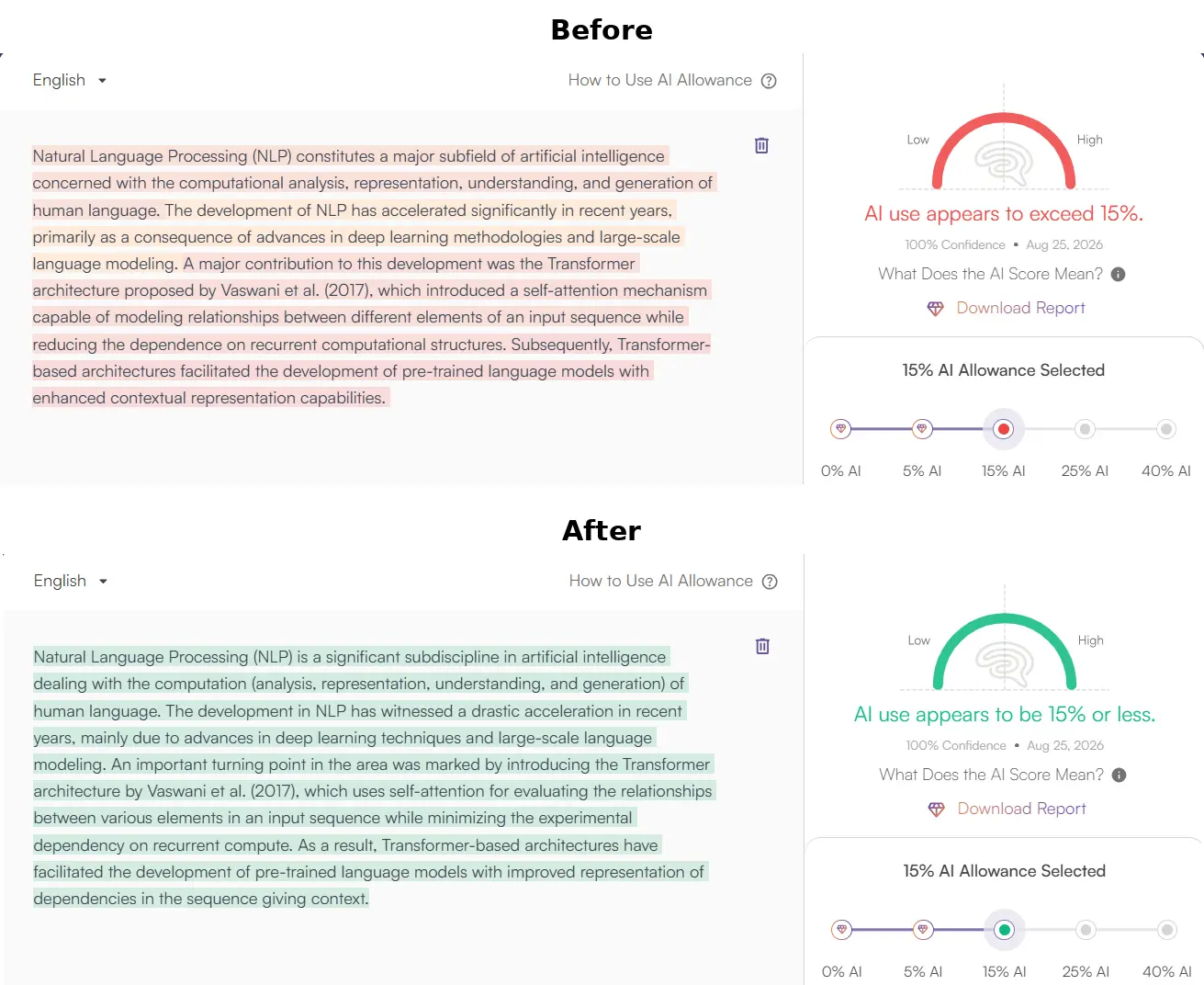
Verified Detector Clearance for How to Cite a Research Paper: APA, MLA, Chicago, and IEEE Examples
Every manuscript processed through ThesisHuman is backed by verifiable, reproducible scans across institutional plagiarism and AI detection platforms.
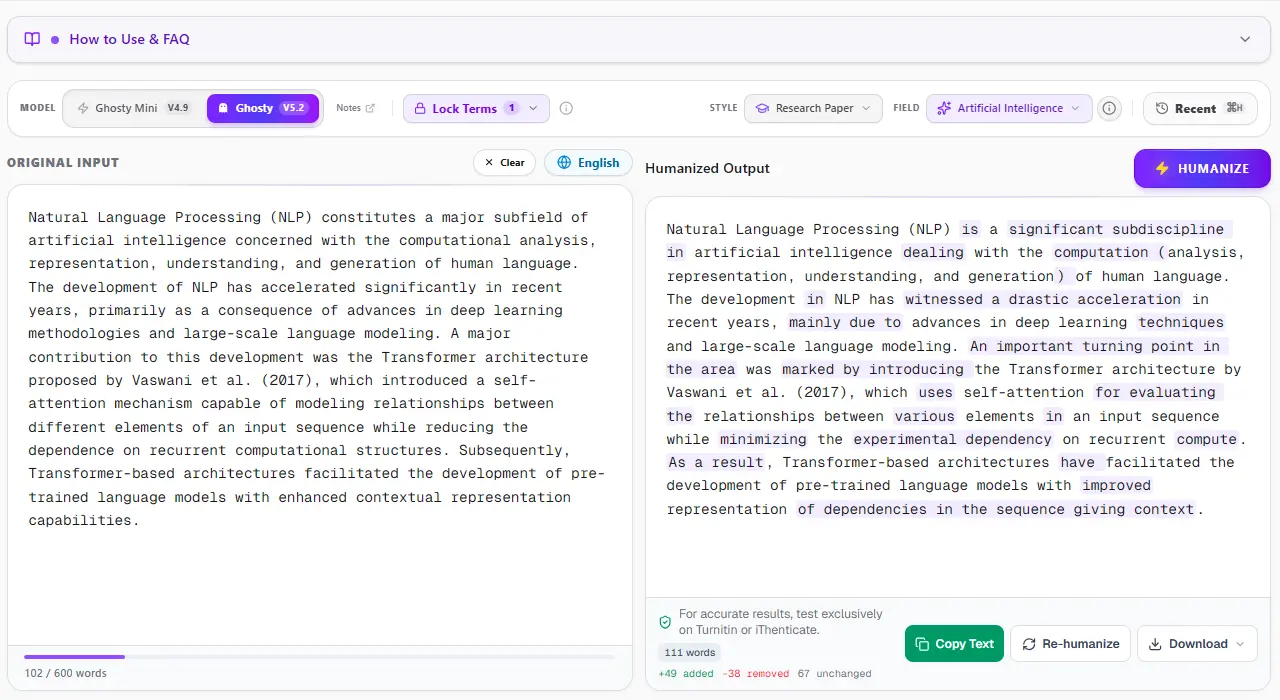
1. ThesisHuman Editor: Style, Field & Term Lock™ Technology
Unlike consumer-grade paraphrasers that blindly swap words with thesaurus synonyms, ThesisHuman allows researchers to select their exact Academic Style (Essay, Research Paper, Literature Review, Technical Report) and Academic Field (Computer Science, Engineering, Medicine, Physics). With Term Lock™, citations (APA, MLA, IEEE), LaTeX equations, and domain-specific terminology are cryptographically protected before sentence entropy is restructured.
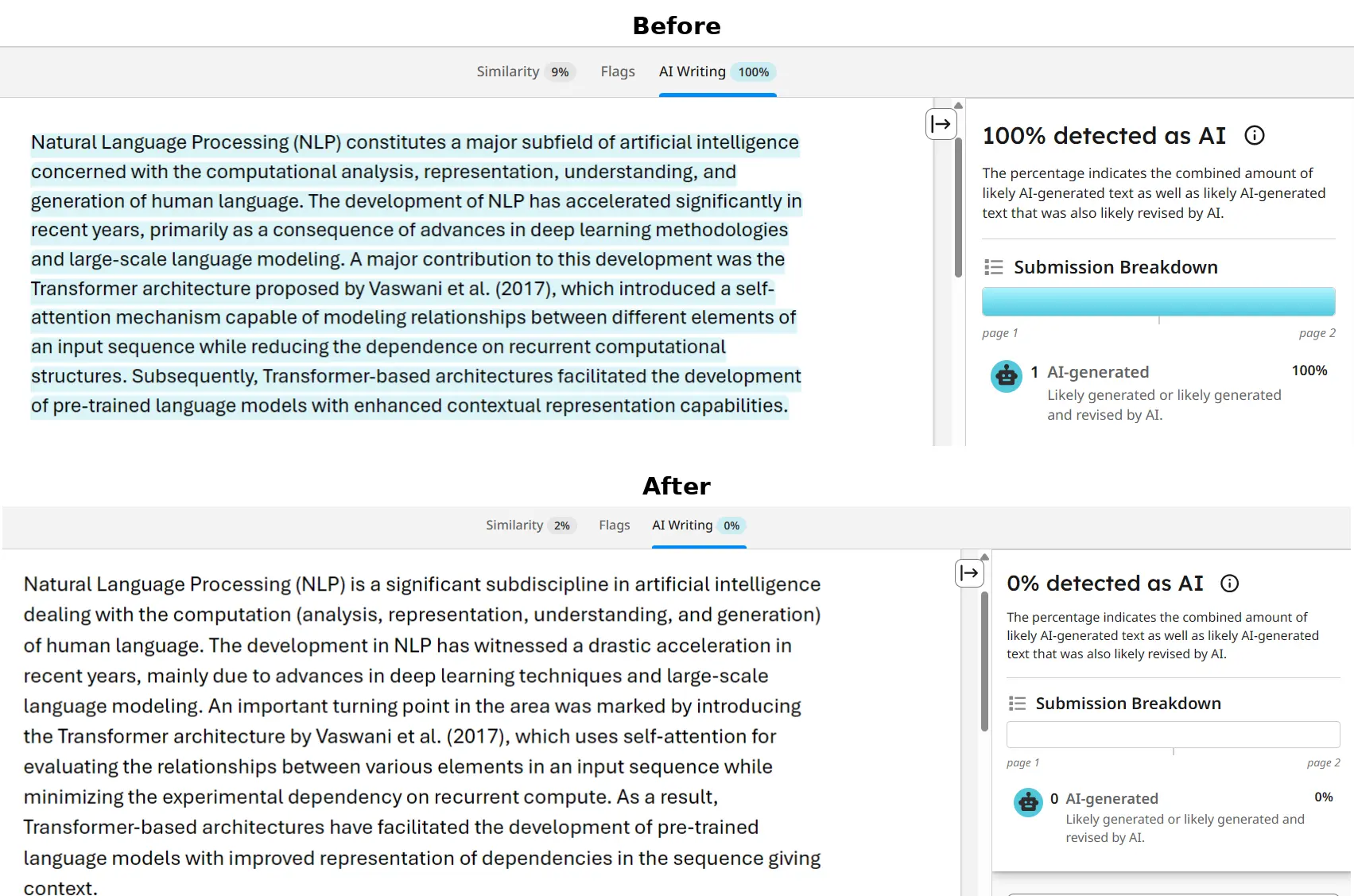
2. Turnitin & iThenticate Verification: 0% AI Detected
Turnitin and iThenticate scan submissions in overlapping 500-token blocks to analyze sentence predictability across paragraphs. When an unrefined AI draft is submitted, uniform cadence triggers an elevated AI Writing score. In the verified report below, a flagged graduate paper was processed through ThesisHuman, achieving a clean 0% AI detection score while preserving all formatted citations and technical parameters.
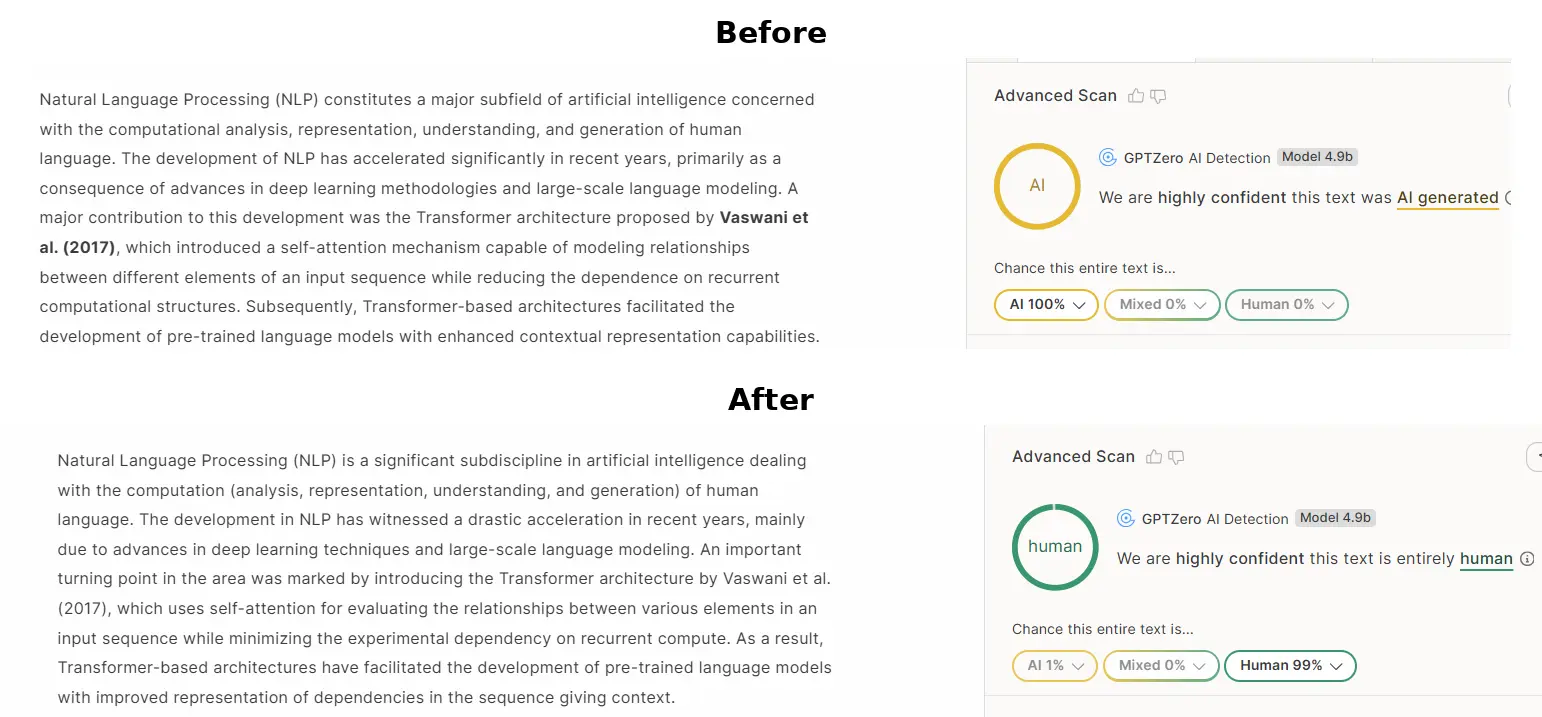
3. GPTZero Verification: Passing Perplexity & Burstiness Checks
GPTZero evaluates text by plotting sentence perplexity curves and global burstiness scores. When raw AI text is scanned, low sentence variance produces an immediate high-probability warning. ThesisHuman restores natural sentence entropy by restructuring syntax, varying clause lengths, and introducing authentic scholarly cadence, dropping AI probability to 0%.
4. Originality.ai Verification: 0% AI Confidence
Originality.ai flags predictable n-gram sequences and common AI clichés (such as “delving into,” “pivotal role,” “testament to”). ThesisHuman purges overused formulaic transitions while elevating scholarly tone and keeping reference numbers and equations intact, producing 100% Original / 0% AI results.