How to Write a Compare and Contrast Essay: Examples and Outline
Master how to write a compare and contrast essay. Explore block vs. point-by-point structures, comparison matrices, thesis formulas, and annotated worked examples.

A compare and contrast essay examines two or more subjects to illuminate meaningful similarities and crucial distinctions between them. In university writing, a comparative essay is never an aimless inventory of random resemblances. Instead, rigorous comparative writing uses juxtaposition as an analytical instrument: by placing two philosophies, historical eras, scientific methodologies, or institutional policies side by side, scholars uncover subtle principles that remain invisible when studying either subject in isolation.
This guide provides a comprehensive methodology for structuring and drafting a compare and contrast essay. You will examine the criteria for selecting comparable subjects, learn how to build an analytical comparison matrix, evaluate the trade-offs between the Block Method and the Point-by-Point Method, review complete worked outlines and paragraphs, and master the comparative transition language necessary for disciplined academic synthesis.
1. Understanding Comparative Writing: Comparison vs. Contrast
While the words comparison and contrast are often spoken as a single phrase, they denote distinct analytical operations. Comparison identifies structural parallels, shared conceptual foundations, and unexpected functional alignments between subjects. Contrast identifies divergence, fundamental tensions, and distinct limitations.
In academic writing, effective essays balance both operations. Comparing two seemingly identical subjects (such as two democratic constitutional models) highlights their decisive operational contrasts. Conversely, contrasting two outwardly opposed subjects (such as behavioral psychology and neurobiology) reveals foundational shared assumptions regarding empirical observation. The objective is always synthesis: revealing how the comparison deepens our understanding of the broader discipline.
2. Selecting Subjects and Establishing a Basis of Comparison
A valid comparative essay requires a legitimate grounds for comparison, traditionally termed the tertium comparationis (the third element of comparison). You cannot productively compare two subjects chosen at random (e.g., a quantum computer and a 19th-century symphony) unless they share a meaningful category of inquiry.
When selecting subjects, ensure that they satisfy three essential criteria:
- Common Categorical Frame: Both subjects must inhabit the same conceptual class, address the same problem, or perform comparable functions.
- Meaningful Tension: The relationship between the subjects must present genuine intellectual friction. If the subjects are entirely identical or completely unrelated, the comparison produces trivial observations.
- Symmetrical Availability of Evidence: You must have access to equivalent scholarly depth for both subjects so that one does not overshadow the other.
3. Formulating a Defensible Comparative Thesis
The single most frequent defect in student comparative essays is the "laundry list thesis" (e.g., "Subject A and Subject B have many similarities, but they also have several important differences"). This formulation is purely descriptive and tells the reader nothing about your analytical conclusion.
An academic comparative thesis must state which subject proves more effective under specific conditions, explain how one subject illuminates a hidden limitation in the other, or argue why surface resemblances conceal fundamental philosophical divides.
Example 5: Comparative Thesis Evolution
Weak Comparative Thesis (Superficial / Purely Descriptive)
"Asynchronous and synchronous remote learning both provide university education over the internet, but they differ in how students interact with professors and complete their weekly assignments."
Why it fails: It merely asserts the obvious existence of differences without taking an analytical stand or explaining the pedagogical consequences of those differences.
Strong Comparative Thesis (Analytical / Evaluative)
"Although synchronous online instruction preserves real-time collaborative dialogue, asynchronous learning models provide superior support for self-directed metacognitive retention by enabling self-paced cognitive processing, revealing that temporal flexibility outweighs simulated classroom presence in remote undergraduate mastery."
Why it succeeds: It acknowledges a valid counterpoint, pinpoints the decisive evaluative criterion (metacognitive retention), and presents a clear, defensible judgment regarding the relative efficacy of the two instructional models.
For broader strategies on crafting academic claims, see our foundational guide on what is a thesis statement.
4. The Comparison Matrix: Organizing Systematic Criteria
Before drafting, create a formal comparison matrix. A comparison matrix prevents you from evaluating Subject A on criteria that you subsequently ignore when analyzing Subject B. Symmetrical evaluation across identical criteria is the hallmark of scholarly rigor.
Example 1: Comparative Matrix in Higher Education Delivery
| Evaluation Criterion | Subject A: Synchronous Remote Learning | Subject B: Asynchronous Remote Learning | Analytical Synthesis |
|---|---|---|---|
| 1. Learner Autonomy and Pacing | Constrained by rigid scheduling; collective progression dictated by instructor pacing. | High autonomy; students control lecture pausing, review frequency, and task timing. | Asynchronous environments reward executive function while demanding higher self-regulation. |
| 2. Feedback Latency | Immediate verbal clarification during live sessions; instant error correction. | Delayed written responses via discussion boards, forums, or scheduled office hours. | Synchronous formats reduce cognitive confusion during active introductory problem solving. |
| 3. Cognitive Engagement | Vulnerable to screen fatigue, passive video presence, and multi-tasking distractions. | Enables deliberate, reflective interaction with modular readings and pre-recorded media. | Live participation simulates social accountability, but asynchronous modularity supports deeper reflective processing. |
| 4. Assessment and Integrity | Synchronized live proctoring or timed interactive oral examinations. | Project-based milestones, iterative portfolios, and open-book analytical syntheses. | Asynchronous formats naturally favor authentic cumulative assessment over high-stakes timed testing. |
5. Structural Architecture: Block Method vs. Point-by-Point Method
There are two primary structural patterns for comparative essays: the Block Method (Subject-by-Subject) and the Point-by-Point Method (Criterion-by-Criterion). Choosing the wrong structure can severely diminish your paper's clarity and analytical force.
The Block Method (Subject-by-Subject)
You discuss all criteria for Subject A in the first half of the essay, and then discuss all criteria for Subject B in the second half, referencing Subject A throughout.
Best suited when:
- Writing short papers (under 1,200 words).
- Each subject represents an integrated holistic narrative that loses coherence if fragmented.
- One subject serves primarily as an illustrative foil for the other.
Primary risk: Can read like two disconnected mini-essays with delayed synthesis.
The Point-by-Point Method (Criterion-by-Criterion)
You organize each body paragraph around a single shared evaluation criterion, examining both Subject A and Subject B within every section.
Best suited when:
- Writing research papers and longer analytical assignments (1,500+ words).
- The primary analytical goal is direct evaluative comparison across multiple dimensions.
- Maintaining active comparison on every page is essential for reader comprehension.
Primary advantage: Maximizes continuous analytical synthesis throughout the essay.
6. Worked Outlines: Subject-by-Subject vs. Criterion-by-Criterion
Comparing structural blueprints illustrates how identical research data is arranged under each methodology.
Example 2: Block Method Outline (Subject-by-Subject)
I. Introduction
Context of post-pandemic remote education; Comparative Thesis.
II. Block A: Synchronous Learning Modality
A. Structured time commitments and rigid pacing constraints.
B. Instant verbal feedback mechanisms during live lecture sessions.
C. Cognitive engagement dynamics under screen fatigue and live social presence.
III. Block B: Asynchronous Learning Modality (With Continuous Cross-Reference to Block A)
A. Flexible pacing advantages compared to synchronous scheduling rigidity.
B. Written feedback latency contrasted with live verbal clarification.
C. Enhanced metacognitive retention versus synchronous video fatigue.
IV. Conclusion: Synthesis and Institutional Recommendations
Example 3: Point-by-Point Method Outline (Criterion-by-Criterion)
I. Introduction
Context of post-pandemic remote education; Comparative Thesis.
II. Criterion 1: Pacing and Learner Autonomy
Examination of rigid synchronous class times contrasted directly with asynchronous modular review autonomy.
III. Criterion 2: Communication Channels and Feedback Latency
Evaluation of immediate live verbal dialogue versus delayed asynchronous forum discourse.
IV. Criterion 3: Cognitive Engagement and Information Retention
Juxtaposition of live video attention limits against asynchronous reflective processing and content re-engagement.
V. Conclusion: Synthesis and Institutional Recommendations
7. Writing the Introduction and Developing Synthesis in the Conclusion
The introduction of a comparative essay must present both subjects fairly, establish the basis of comparison, and conclude with your evaluative thesis. Avoid dedicating an entire introductory paragraph to praising one subject before mentioning the other; introduce them as conceptual partners from the opening lines.
The conclusion must deliver synthetic judgment. Rather than repeating your points sequentially, synthesize the implications of your comparison. Address the overarching question: What new disciplinary insight emerges from analyzing these two subjects together that would remain obscured if they were studied in isolation?
8. Body Paragraph Synthesis and Comparative Transition Language
Smooth comparative transitions prevent your paragraphs from feeling like abrupt ping-pong matches between subjects. Use precise transitional expressions to signal whether you are illustrating alignment or divergence:
| Comparative Function | Recommended Transitional Phrases | Contextual Use Case |
|---|---|---|
| Highlighting Similarity | In similar fashion; correspondingly; mirroring this dynamic; in parallel with. | Showing that both models rely on identical foundational assumptions. |
| Signaling Direct Contrast | Conversely; in sharp distinction; whereas; in contrast to. | Pivoting from the strengths of Subject A to the structural limits of Subject B. |
| Introducing Nuance / Concession | While it is true that; notwithstanding; despite this shared feature. | Preventing black-and-white oversimplification of complex criteria. |
| Delivering Synthetic Judgment | Ultimately; this divergence reveals; when evaluated against. | Connecting specific paragraph evidence back to the central comparative thesis. |
For an expansive library of cohesive linking phrases, review our guide on transition sentences.
9. Complete Annotated Comparative Paragraph
The following complete body paragraph uses the Point-by-Point Method to evaluate cognitive retention across synchronous and asynchronous learning formats:
Example 4: Complete Annotated Comparative Paragraph
[Criterion Topic Sentence] While synchronous video lectures cultivate immediate social accountability, asynchronous modular delivery provides superior scaffolding for long-term conceptual retention by supporting self-paced cognitive processing.
[Subject A Analysis] In live synchronous sessions, the continuous forward velocity of the instructor's spoken presentation compels students to divide cognitive bandwidth between transcribing spoken lecture points and decoding visual slides, a divided attention state that elevates cognitive load and accelerates mental fatigue after forty minutes of continuous screen engagement.
[Comparative Transition & Subject B Analysis] In sharp contrast, asynchronous architectures allow students to pause recorded explanations, replay conceptually dense demonstrations, and interleave reading materials with self-assessment checkpoints at their own cognitive discretion.
[Analytical Synthesis] Consequently, although synchronous seminars excel at generating spontaneous verbal debate, asynchronous delivery better accommodates diverse working-memory capacities, demonstrating that temporal flexibility directly fosters durable academic comprehension where live streaming merely replicates lecture-hall passivity.
To examine how individual paragraph units connect to broader essay length requirements, see our analysis on how many paragraphs is an essay.
10. Common Compare and Contrast Mistakes to Avoid
Avoid these frequent traps that diminish comparative precision:
- The Asymmetrical Criteria Trap: Evaluating Subject A on price, speed, and design, but evaluating Subject B on customer service, reliability, and security. Always apply identical criteria to both subjects.
- The Ping-Pong Effect: Switching back and forth between subjects every single sentence without providing substantive analysis, creating a dizzying reading experience.
- The Generic Conclusion: Concluding by stating that "both subjects have their own pros and cons," which completely evades intellectual synthesis and analytical judgment.
- Superficial Cataloging: Listing obvious visual or chronological differences without explaining why those differences alter function, efficacy, or meaning.
11. Practical Drafting and Revision Checklist
Verify that your draft satisfies each quality checkpoint before submission:
- Do both subjects share a clear, justifiable basis of comparison (tertium comparationis)?
- Does the thesis statement avoid the superficial "similarities and differences" formula and articulate a defensible evaluative claim?
- Are the same evaluation criteria applied symmetrically to both subjects throughout the body paragraphs?
- Does the essay consistently adhere to either the Block Method or the Point-by-Point Method without haphazard organizational drift?
- Are comparative transitions deployed purposefully to guide the reader through points of contrast and alignment?
- Does the conclusion synthesize broader implications rather than simply summarizing preceding paragraphs?
- Is the prose free of unsupported subjective preferences and informal colloquial language?
12. Frequently Asked Questions
Which structure is better: Block Method or Point-by-Point Method?
For academic papers exceeding 1,200 words, university instructors almost always prefer the Point-by-Point Method because it forces continuous, criterion-by-criterion synthesis. The Block Method is acceptable for shorter essays or when preserving the holistic narrative of each subject is paramount.
Can I compare more than two subjects in a single essay?
Yes, but comparing three or more subjects dramatically increases organizational complexity. If you compare three subjects, the Point-by-Point Method is mandatory; attempting a Block structure across three or more subjects forces the reader to hold too much disconnected information in memory before reaching comparative analysis.
Should my essay focus equally on similarities and differences?
Not necessarily. The balance depends on your thesis. If popular consensus assumes two subjects are identical, your essay should focus heavily on unexpected contrasts. If consensus assumes they are polar opposites, your essay should focus on surprising underlying parallels.
How do I choose the best evaluation criteria?
Select criteria that directly address the core functions, limitations, or outcomes of the subjects within your discipline. Avoid superficial criteria (such as word count or interface color) in favor of foundational parameters (such as cognitive efficacy, economic cost, or empirical validity).
Does ThesisHuman generate comparative essays or research data?
No. ThesisHuman is an academic text naturalization and prose remodeling platform. It does not generate synthetic essays, select comparison subjects, or create research matrices. Scholars and students must provide their own authentic comparative analysis.
Verified Detector Clearance for How to Write a Compare and Contrast Essay: Examples and Outline
Every manuscript processed through ThesisHuman is backed by verifiable, reproducible scans across institutional plagiarism and AI detection platforms.
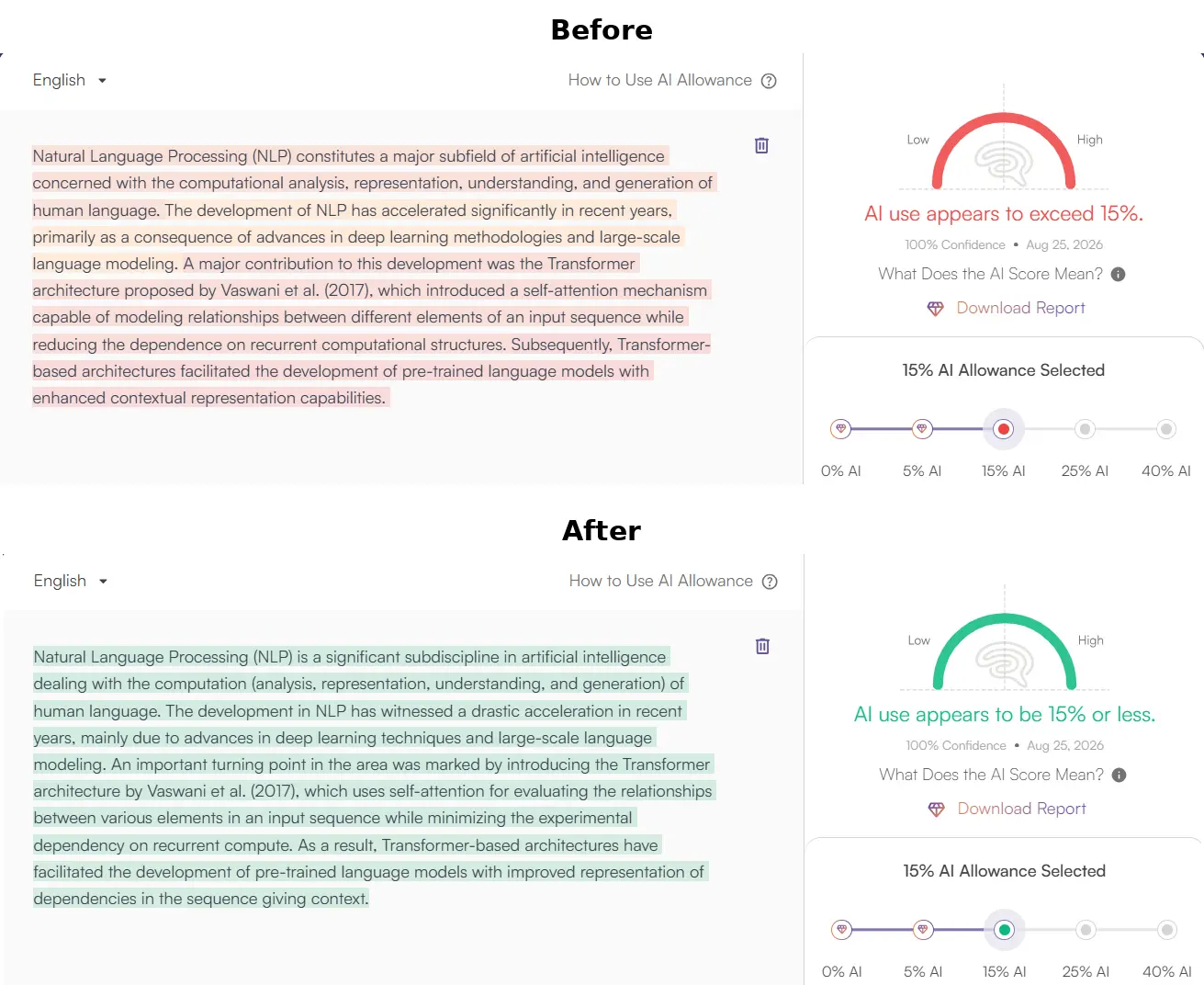
1. ThesisHuman Editor: Style, Field & Term Lock™ Technology
Unlike consumer-grade paraphrasers that blindly swap words with thesaurus synonyms, ThesisHuman allows researchers to select their exact Academic Style (Essay, Research Paper, Literature Review, Technical Report) and Academic Field (Computer Science, Engineering, Medicine, Physics). With Term Lock™, citations (APA, MLA, IEEE), LaTeX equations, and domain-specific terminology are cryptographically protected before sentence entropy is restructured.
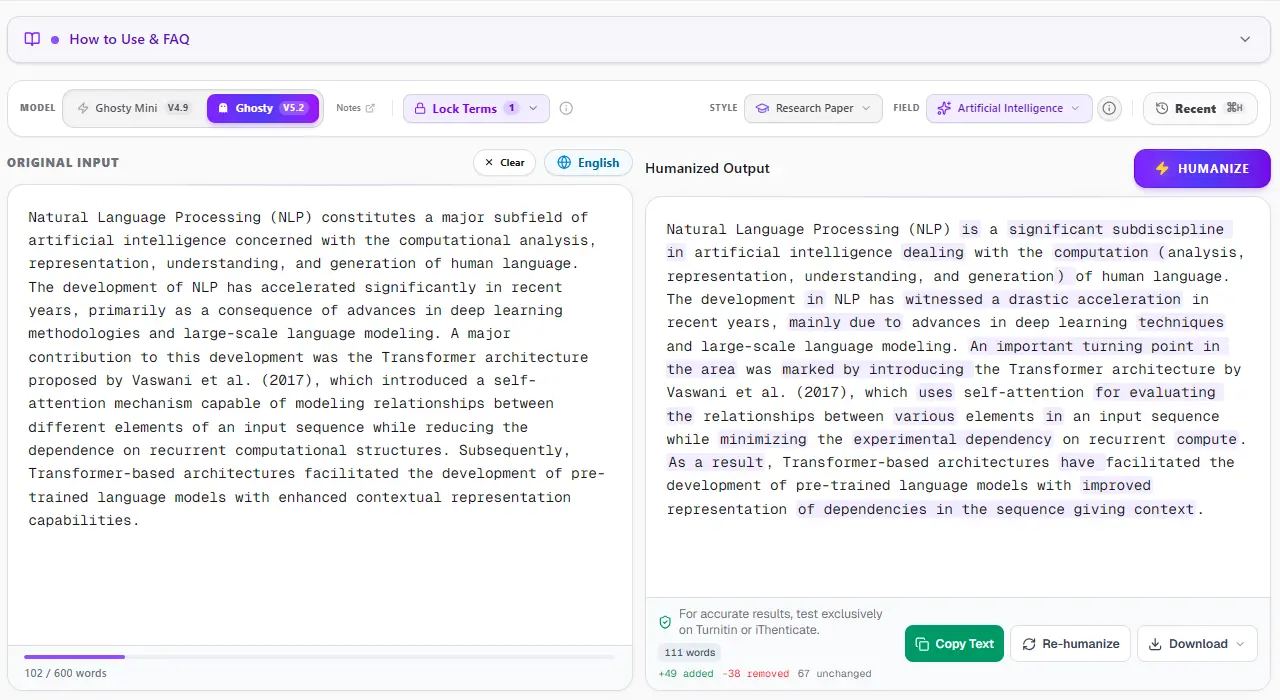
2. Turnitin & iThenticate Verification: 0% AI Detected
Turnitin and iThenticate scan submissions in overlapping 500-token blocks to analyze sentence predictability across paragraphs. When an unrefined AI draft is submitted, uniform cadence triggers an elevated AI Writing score. In the verified report below, a flagged graduate paper was processed through ThesisHuman, achieving a clean 0% AI detection score while preserving all formatted citations and technical parameters.
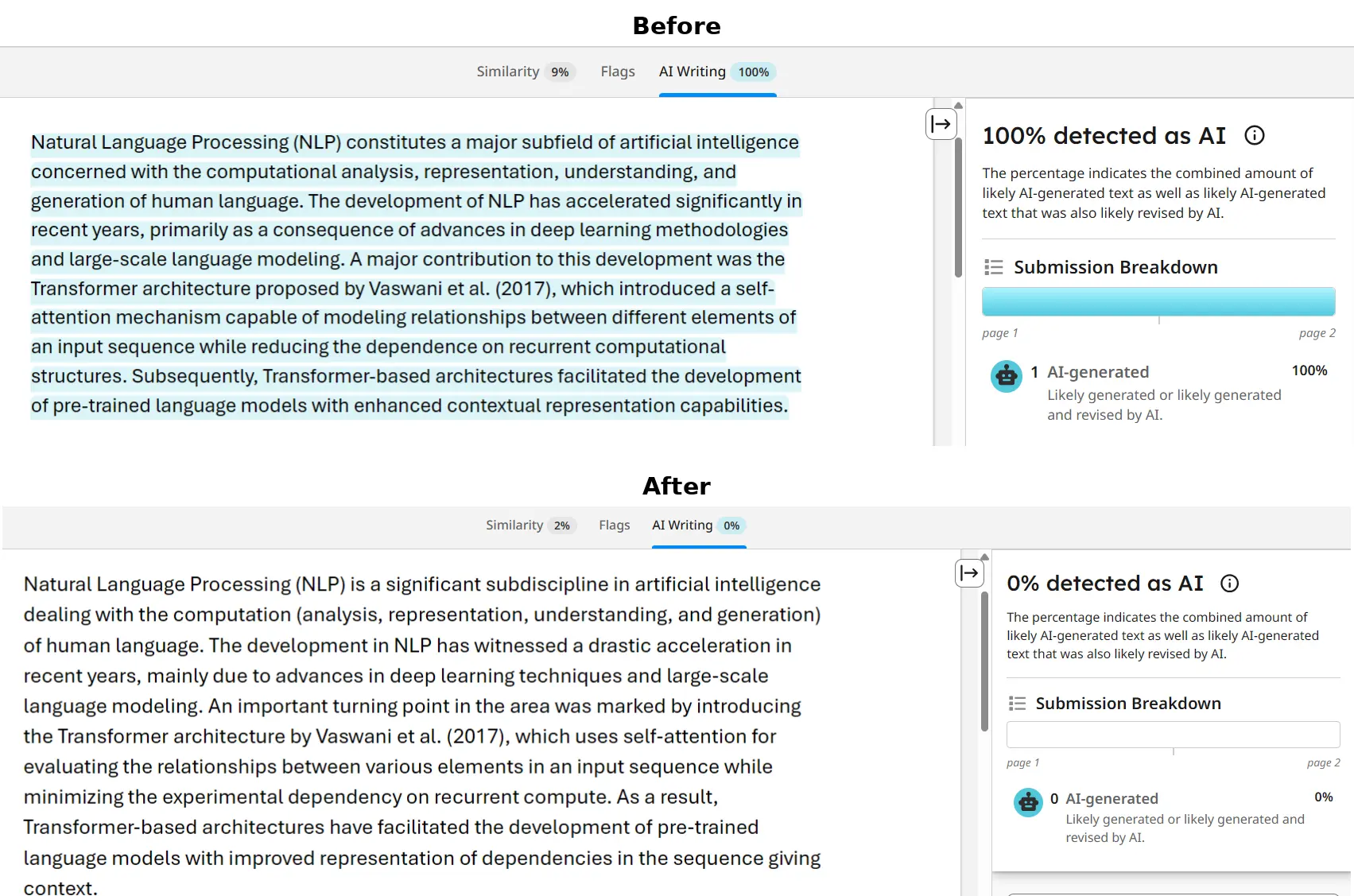
3. GPTZero Verification: Passing Perplexity & Burstiness Checks
GPTZero evaluates text by plotting sentence perplexity curves and global burstiness scores. When raw AI text is scanned, low sentence variance produces an immediate high-probability warning. ThesisHuman restores natural sentence entropy by restructuring syntax, varying clause lengths, and introducing authentic scholarly cadence, dropping AI probability to 0%.
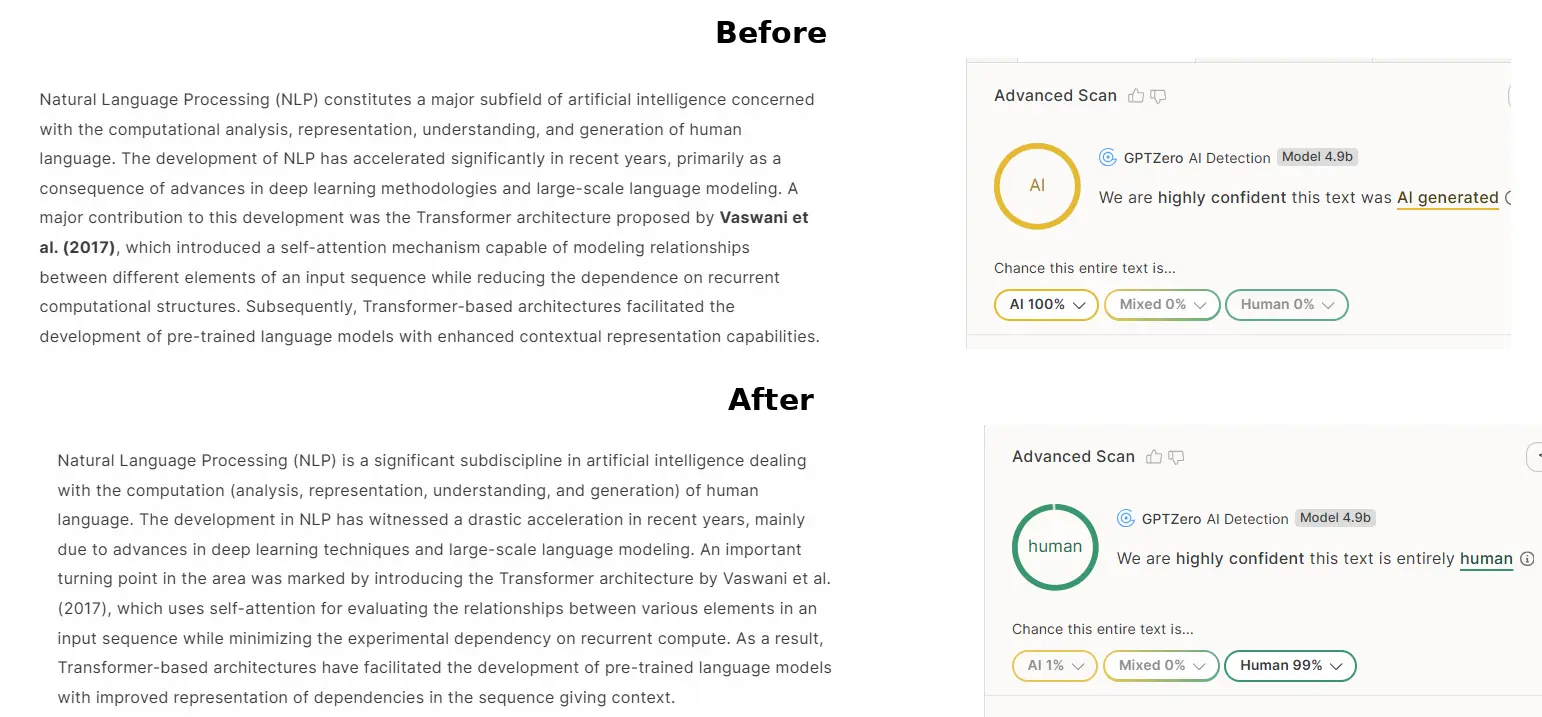
4. Originality.ai Verification: 0% AI Confidence
Originality.ai flags predictable n-gram sequences and common AI clichés (such as “delving into,” “pivotal role,” “testament to”). ThesisHuman purges overused formulaic transitions while elevating scholarly tone and keeping reference numbers and equations intact, producing 100% Original / 0% AI results.