How to Remove Formulaic AI Phrasing from Academic Writing
Dismantle predictable AI sentence templates, artificial triads, and superficial transitions while keeping your academic arguments sharp and precise.

Language models produce recognizable stylistic habits that peer reviewers and detection classifiers notice quickly. These traits go beyond individual buzzwords; they stem from structural tendencies such as repetitive transitions, forced contrasts, and mechanical lists that weaken the precision of scholarly prose.
Polishing an AI-assisted manuscript into publication-ready writing requires identifying these constructions and revising them directly. This guide details frequent AI sentence patterns and offers straightforward editing strategies to restore natural scholarly style.
Beyond Word Lists: The Underlying Syntax of Machine Drafts
Writers often search their text for words like delve, tapestry, or pivotal. While removing those terms helps, modern classifiers like GPTZero (which added explainable AI Patterns in Model 4.9b, as discussed in our GPTZero Model 4.9b analysis) analyze sentence entropy, syntax balance, and paragraph rhythm.
Language models aim for neutral, agreeable continuations. In research drafts, this tendency produces a uniform tone characterized by predictable structural choices:
- Forced Symmetry: Framing every point as a balanced contrast, even when the data shows an uneven outcome.
- Artificial Triads: Grouping nouns, verbs, or descriptors into neat sets of three to sound comprehensive.
- Vague Attributions: Using phrases like "scholars generally agree" or "current research indicates" without naming researchers or studies.
Replacing Artificial Antithesis
A frequent marker in AI drafts is the repeated negative parallelism construction, such as "It is not merely X, but rather Y" or "Not only does this approach accomplish X, but it also improves Y."
Academic writers use contrastive framing when distinguishing between competing hypotheses. Overusing the structure creates slow prose that postpones the main empirical point.
| Formulaic Phrasing | Direct Academic Revision | Result |
|---|---|---|
| "This method is not merely a theoretical exercise; rather, it provides a foundational framework for empirical validation." | "This method establishes an empirical validation protocol for high-throughput assays." | States the contribution without unnecessary preamble. |
| "Not only does temperature regulate reaction velocity, but it also profoundly impacts catalytic stability." | "Elevated temperature accelerates reaction velocity while degrading catalytic stability above 65°C." | Provides specific conditions and removes filler. |
Cutting Participial Tails
Language models often tack explanatory participial phrases onto the ends of sentences, adding lines like "thereby underscoring the necessity of further investigation" or "highlighting the complex factors involved."
These trailing clauses rarely contribute new information. In most cases, removing them clarifies the statement. When the secondary thought contains a relevant point, integrate it as a separate clause with supporting evidence. For related editing advice, see How to Humanize AI Text for Academic Writing.
Restoring Natural Sentence Burstiness
Human academic writing varies in pace. A researcher might open with a concise summary sentence, follow with a longer sentence detailing experimental parameters, and finish with a direct conclusion. In contrast, language models cluster sentences tightly around an average length of 18 to 24 words.
Varying sentence length and clause structure provides natural variation. Mixing short declarations with compound technical explanations reflects how scholars communicate.
A Step-by-Step Editing Workflow
When revising an AI-assisted manuscript:
- Check for Empty Adverbs: Review and prune intensifiers like crucially, notably, seamlessly, and comprehensively.
- Identify Evidence Sources: Replace general statements like "It has been observed that" with specific citations or experimental descriptions.
- Apply Term Lock: Use the ThesisHuman editor to adjust sentence variation while locking formulas, mathematical variables, and citation keys.
- Review Pre-Submission Requirements: Check your final draft against The AI-Assisted Research Paper Pre-Submission Checklist before journal submission.
Verified Detector Clearance for How to Remove Formulaic AI Phrasing from Academic Writing
Every manuscript processed through ThesisHuman is backed by verifiable, reproducible scans across institutional plagiarism and AI detection platforms.
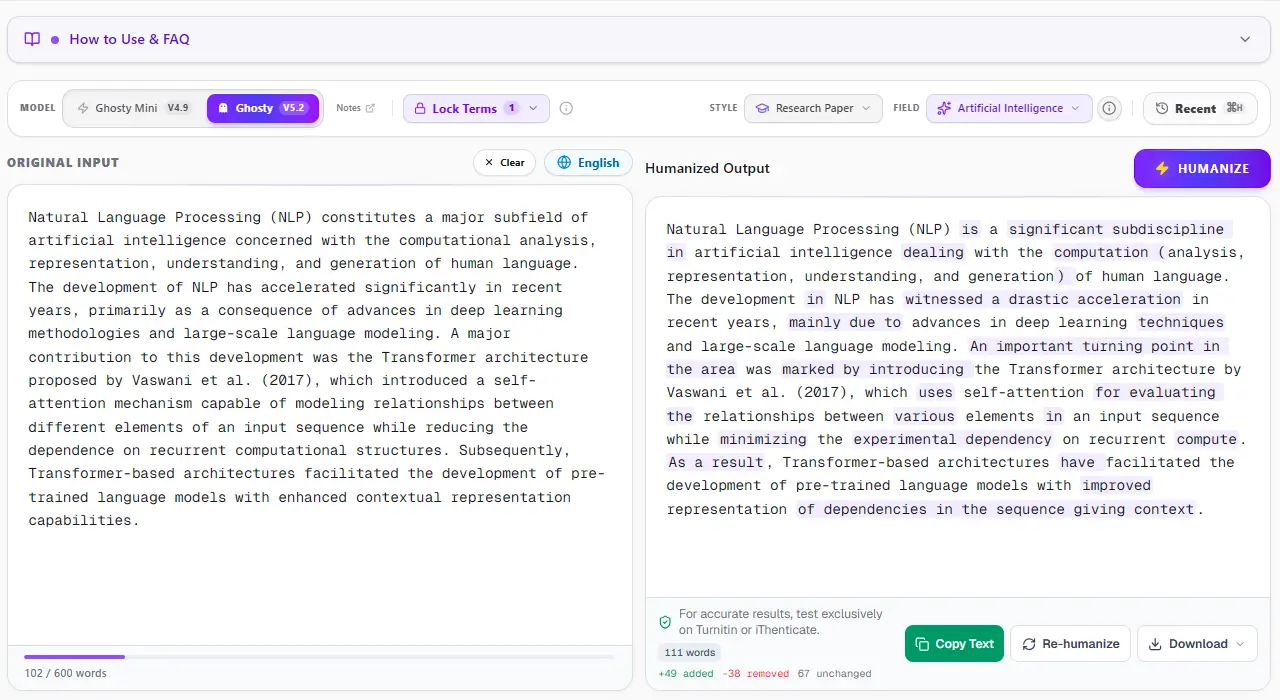
1. ThesisHuman Editor: Style, Field & Term Lock™ Technology
Unlike consumer-grade paraphrasers that blindly swap words with thesaurus synonyms, ThesisHuman allows researchers to select their exact Academic Style (Essay, Research Paper, Literature Review, Technical Report) and Academic Field (Computer Science, Engineering, Medicine, Physics). With Term Lock™, citations (APA, MLA, IEEE), LaTeX equations, and domain-specific terminology are cryptographically protected before sentence entropy is restructured.
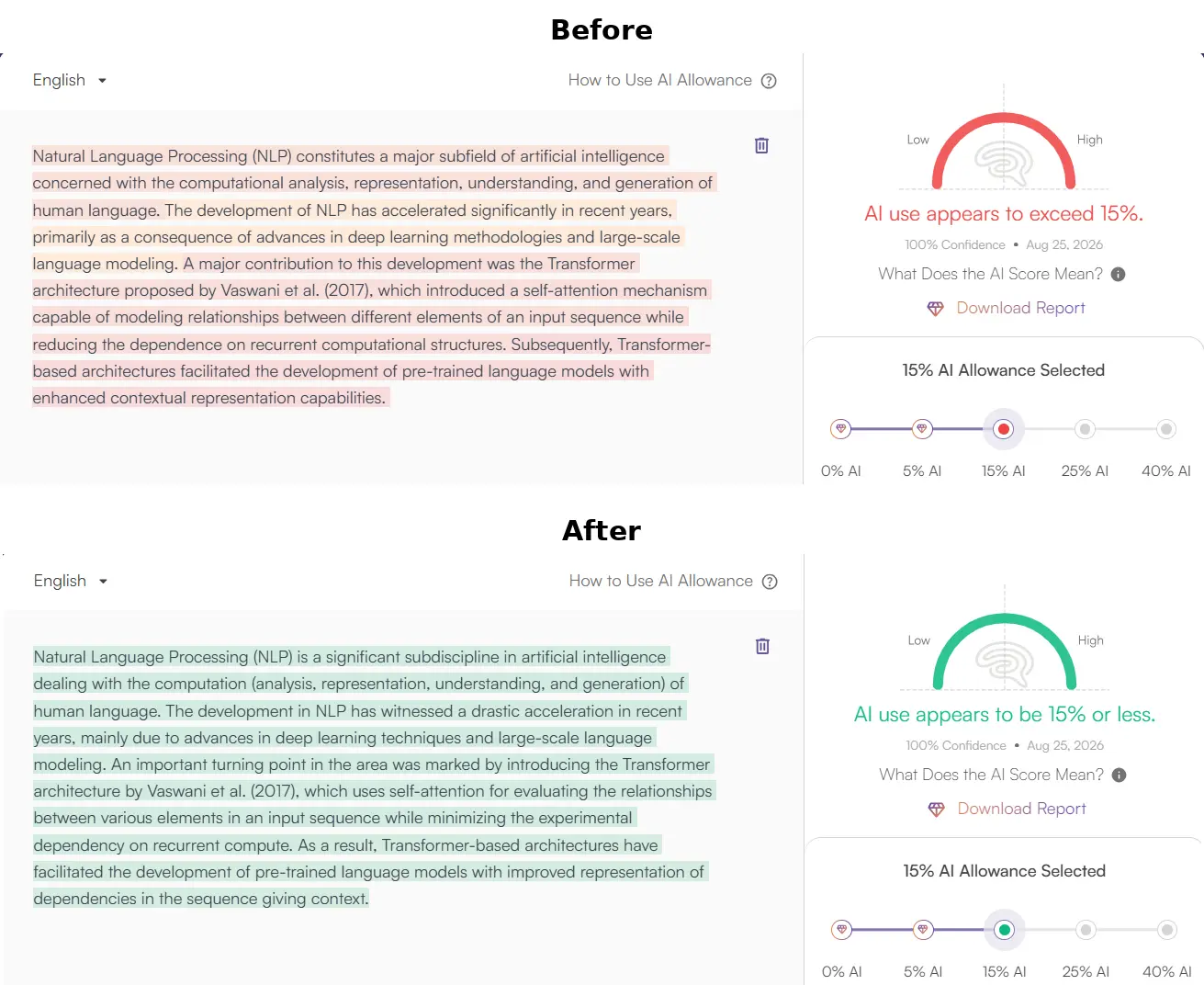
2. Turnitin & iThenticate Verification: 0% AI Detected
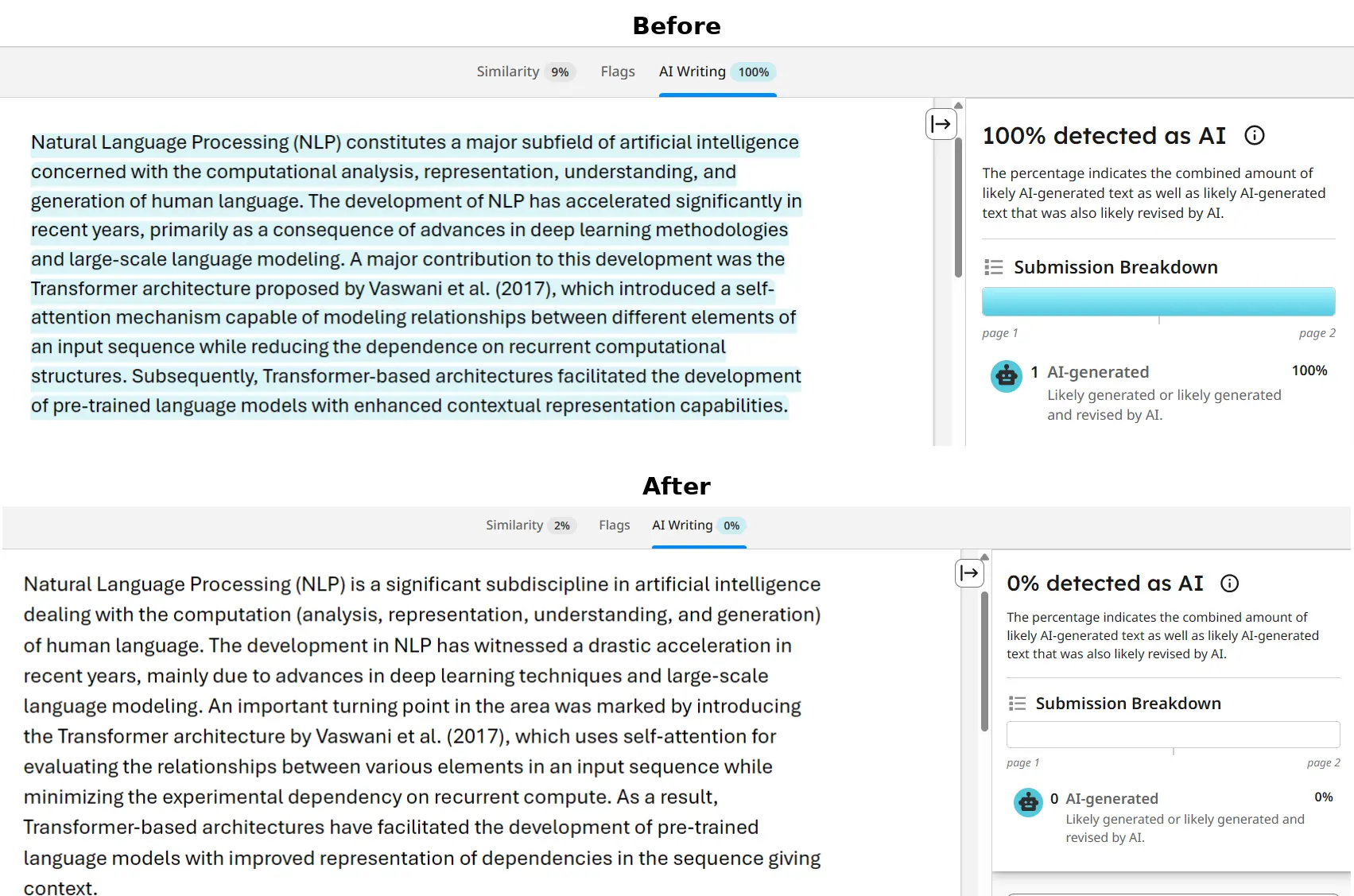
Turnitin and iThenticate scan submissions in overlapping 500-token blocks to analyze sentence predictability across paragraphs. When an unrefined AI draft is submitted, uniform cadence triggers an elevated AI Writing score. In the verified report below, a flagged graduate paper was processed through ThesisHuman, achieving a clean 0% AI detection score while preserving all formatted citations and technical parameters.
3. GPTZero Verification: Passing Perplexity & Burstiness Checks
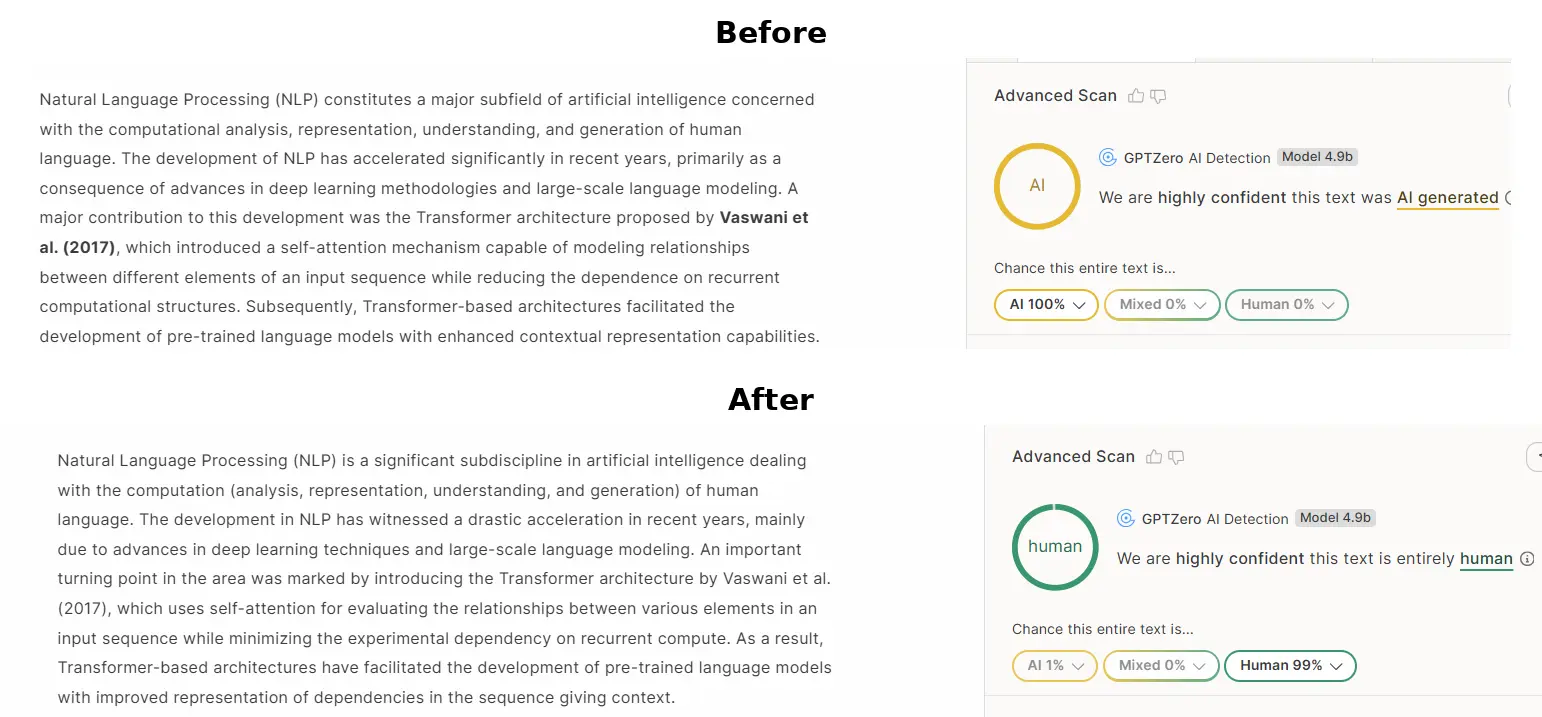
GPTZero evaluates text by plotting sentence perplexity curves and global burstiness scores. When raw AI text is scanned, low sentence variance produces an immediate high-probability warning. ThesisHuman restores natural sentence entropy by restructuring syntax, varying clause lengths, and introducing authentic scholarly cadence, dropping AI probability to 0%.
4. Originality.ai Verification: 0% AI Confidence
Originality.ai flags predictable n-gram sequences and common AI clichés (such as “delving into,” “pivotal role,” “testament to”). ThesisHuman purges overused formulaic transitions while elevating scholarly tone and keeping reference numbers and equations intact, producing 100% Original / 0% AI results.