GPTZero AI Patterns and Model 4.9b: What Changed for Academic Writing
An analysis of GPTZero's August 2026 updates: paratext masking in Model 4.9b, the AI Patterns feature in Advanced Scan, and how to edit manuscripts effectively.

In August 2026, GPTZero released two updates that alter how academic manuscripts are screened. On August 12, 2026, GPTZero deployed Model 4.9b (identified in system records as 2026-08-09-base), aimed at improving detection across newer language models. Earlier, on August 19, 2026, GPTZero introduced an explainable AI Patterns tool in its Advanced Scan interface, adding qualitative stylistic indicators alongside overall percentage scores.
For university researchers, graduate authors, and reviewers, these updates change how screening reports are presented. Understanding how Model 4.9b processes scholarly text and what the new pattern labels indicate helps ensure manuscripts are reviewed accurately. This guide examines the changes and outlines a practical review workflow.
Model 4.9b and AI Patterns
The August 2026 releases reflect two ongoing adjustments in automated detection: adapting to updated language models and addressing the limitation of single percentage outputs. The changes took place in two steps:
- Model 4.9b Release (August 12, 2026): Built to improve detection recall on outputs from frontier models like Claude 5, GPT-5, and Gemini 3.6, with specific focus on compound sentences and academic phrasing.
- AI Patterns in Advanced Scan (August 19, 2026): This interface feature highlights specific sentences with labels explaining why a passage raised statistical flags, rather than showing only a general probability number.
Paratext Masking and Document Boundaries
Beginning with Model 4.8b on August 1 and continuing in Model 4.9b, GPTZero uses an approach called Meaningful AI Detection. The system identifies and masks out document paratext, including section headers, URLs, and references:
| Document Element | Visual Tag | Scoring Role |
|---|---|---|
| Section Titles and Headings | Gray Highlight | Excluded from overall perplexity calculations |
| Bibliographies and Citation Lists | Gray Highlight | Masked out so standardized reference formatting does not inflate scores |
| Core Body Paragraphs | Yellow / Red Highlight | Evaluated directly by Model 4.9b entropy and burstiness classifiers |
This masking helps prevent reference lists and routine headings from elevating a paper's score. At the same time, it concentrates evaluation on the substantive arguments in the body text.
What the Pattern Categories Track
The AI Patterns feature categorizes several recurring writing traits identified in natural language processing literature and community research, such as Wikipedia's AI writing indicators:
- Forced Triads: The recurring tendency of language models to arrange examples or descriptors in groups of three.
- Contrastive Dilemmas: Repeated "Not X, but Y" framing that sets up artificial distinctions.
- Elevated Symbolism: Using dramatic terms like tapestry, pivotal, or testament for ordinary empirical findings.
- Participial Tails: Adding "-ing" clauses to the ends of sentences without contributing substantive evidence.
Distinguishing Style Patterns from Misconduct
It is important for instructors, review committees, and students to recognize that a stylistic pattern tag is not proof of academic dishonesty. Human researchers frequently use parallelism, balanced sentences, and structured lists when explaining detailed concepts.
As detailed in our analysis of AI Detector False Positives and Non-Native English, multilingual authors writing in English often rely on standard rhetorical structures. An AI Pattern flag highlights a stylistic correlation rather than conclusive evidence of origin.
An Editing Workflow for Researchers
When reviewing a paper with Model 4.9b and AI Patterns in mind:
- Revise Flagged Structures: If an indicator highlights repetitive syntax, adjust sentence lengths and clause arrangements directly, as described in How to Remove Formulaic AI Phrasing from Academic Writing.
- Confirm Citation Accuracy: Ensure your bibliography and formulas are verified using our citation verification protocol and LaTeX-safe editing rules.
- Adjust Rhythm with ThesisHuman: Run your text through ThesisHuman with Term Lock enabled to vary sentence structure while keeping citations protected.
- Complete Pre-Submission Checks: Cross-check your manuscript against The AI-Assisted Research Paper Pre-Submission Checklist before final deposit.
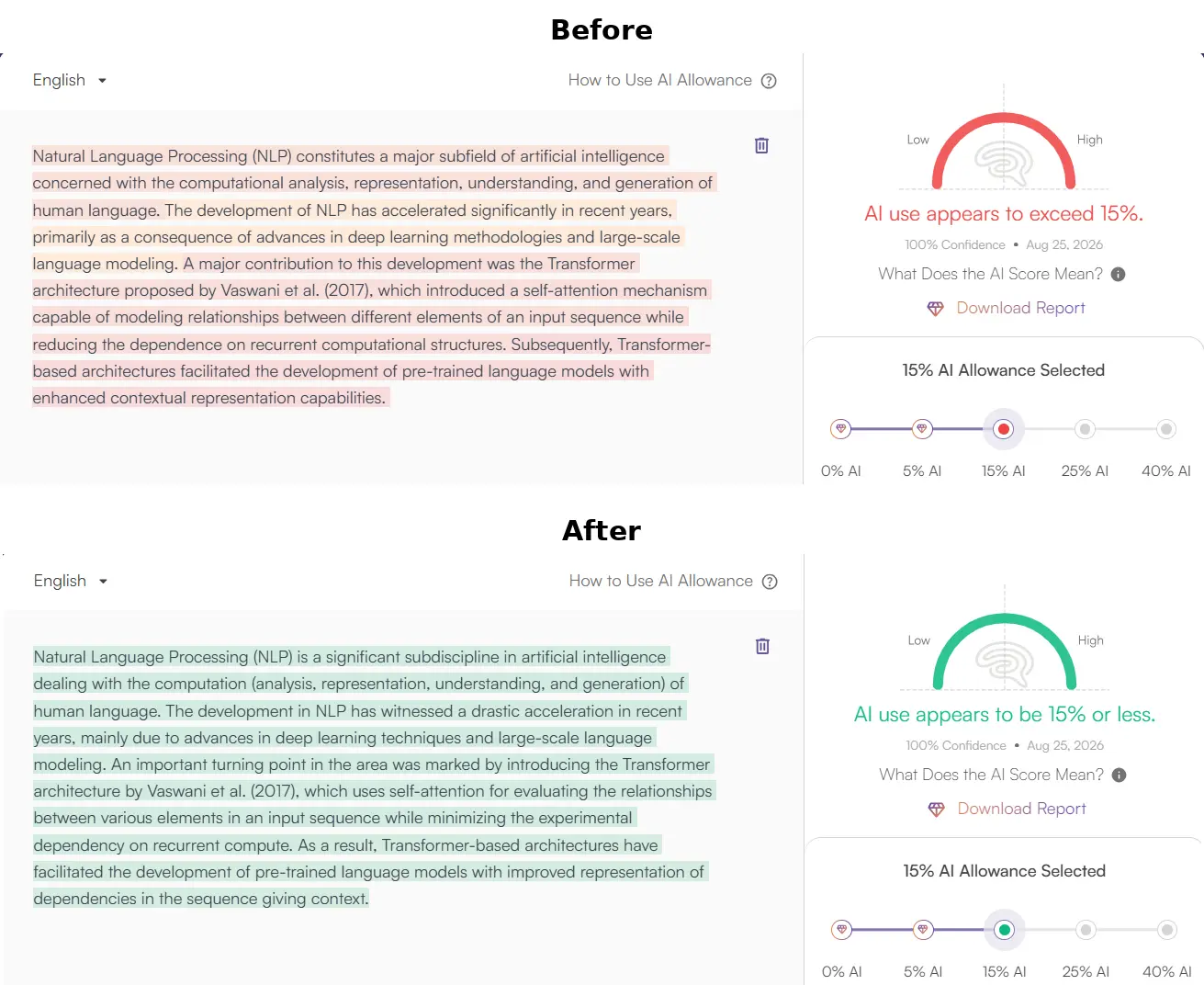
Verified Detector Clearance for GPTZero AI Patterns and Model 4.9b: What Changed for Academic Writing
Every manuscript processed through ThesisHuman is backed by verifiable, reproducible scans across institutional plagiarism and AI detection platforms.
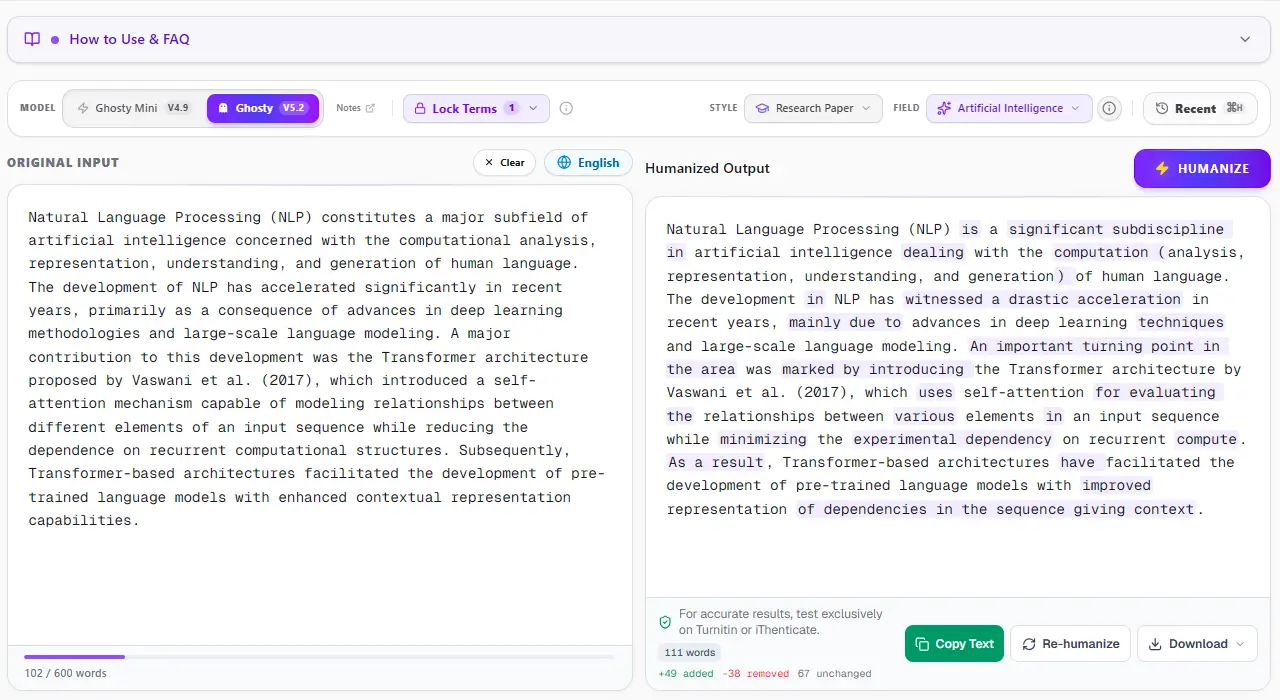
1. ThesisHuman Editor: Style, Field & Term Lock™ Technology
Unlike consumer-grade paraphrasers that blindly swap words with thesaurus synonyms, ThesisHuman allows researchers to select their exact Academic Style (Essay, Research Paper, Literature Review, Technical Report) and Academic Field (Computer Science, Engineering, Medicine, Physics). With Term Lock™, citations (APA, MLA, IEEE), LaTeX equations, and domain-specific terminology are cryptographically protected before sentence entropy is restructured.
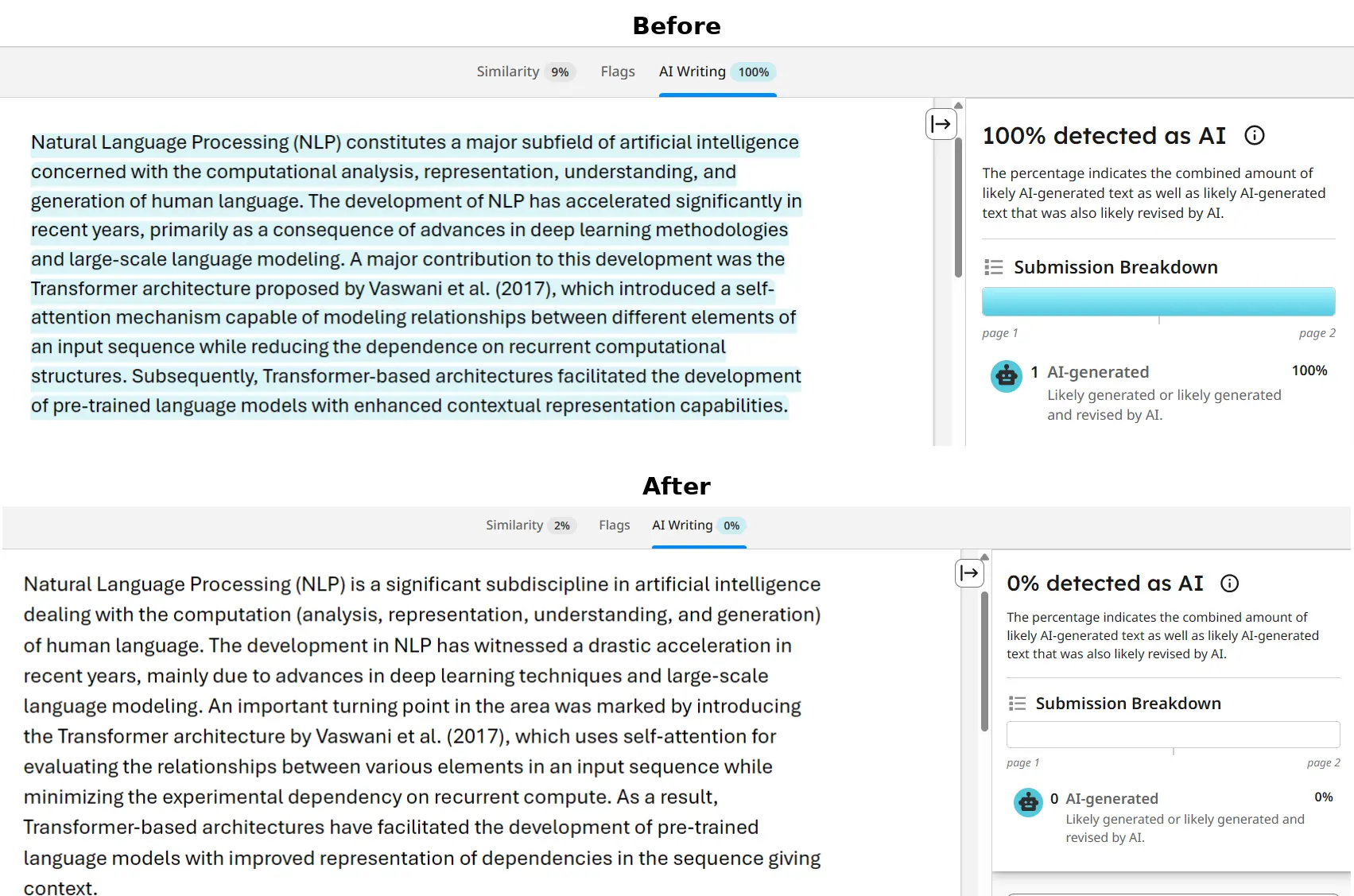
2. Turnitin & iThenticate Verification: 0% AI Detected
Turnitin and iThenticate scan submissions in overlapping 500-token blocks to analyze sentence predictability across paragraphs. When an unrefined AI draft is submitted, uniform cadence triggers an elevated AI Writing score. In the verified report below, a flagged graduate paper was processed through ThesisHuman, achieving a clean 0% AI detection score while preserving all formatted citations and technical parameters.
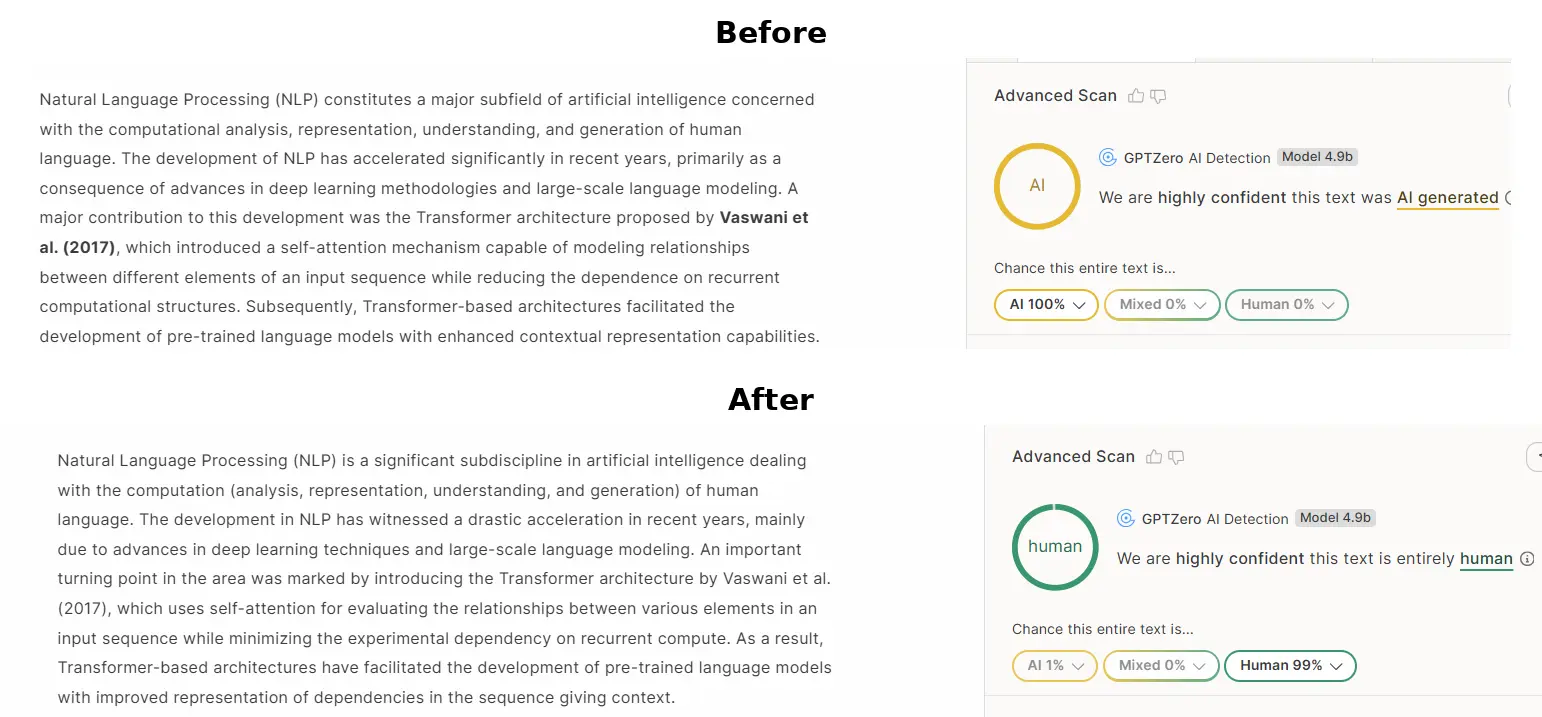
3. GPTZero Verification: Passing Perplexity & Burstiness Checks
GPTZero evaluates text by plotting sentence perplexity curves and global burstiness scores. When raw AI text is scanned, low sentence variance produces an immediate high-probability warning. ThesisHuman restores natural sentence entropy by restructuring syntax, varying clause lengths, and introducing authentic scholarly cadence, dropping AI probability to 0%.
4. Originality.ai Verification: 0% AI Confidence
Originality.ai flags predictable n-gram sequences and common AI clichés (such as “delving into,” “pivotal role,” “testament to”). ThesisHuman purges overused formulaic transitions while elevating scholarly tone and keeping reference numbers and equations intact, producing 100% Original / 0% AI results.