Why AI Detectors Disagree on the Same Academic Paper
Turnitin, GPTZero, Copyleaks, and Originality.ai often return conflicting scores. Here is what their different models measure, how token windows work, and how to interpret the results.

It is common for different AI detection tools to return conflicting evaluations of the same paper. Scanning a thesis section might yield 0 percent on GPTZero, 65 percent on Copyleaks, and an asterisk on Turnitin. These differences can create uncertainty about which report reflects the draft accurately.
AI detectors do not measure machine authorship directly. Instead, they evaluate statistical characteristics that correlate with generated language, using different model designs, reference corpora, and scoring thresholds. This guide reviews why detection outputs diverge and how authors should evaluate contradictory scores.
Detectors Track Different Statistical Features
The main reason detectors produce different results is that each software platform monitors different statistical indicators:
- Perplexity and Burstiness Systems (such as GPTZero): Calculate how predictable each word is compared to a reference model and measure sentence length variance across paragraphs.
- Classifier Networks (such as Turnitin and Originality.ai): Pass text through fine-tuned transformer networks that map token sequences into embedding spaces, comparing passages to training clusters of human and synthetic text.
- Sequence and Phrase Matchers: Search for common language model transition patterns and recurring multi-word phrases.
Because platforms evaluate different indicators, a passage with specialized academic vocabulary but uniform sentence lengths might score low on GPTZero while triggering higher flags on other systems.
Document Segmentation and Token Windows
The way a tool divides a document affects its output score. Commercial systems analyze text in distinct block sizes:
| Platform | Segmentation Method | Scoring Effect |
|---|---|---|
| Turnitin and iThenticate | Overlapping blocks of roughly 500 tokens (around 300 words) | Averages over larger spans; suppresses scores below 20 percent |
| GPTZero (Model 4.9b) | Sentence-level perplexity with paratext masking | Evaluates individual sentences; excludes references in gray |
| Copyleaks | Dense sentence-by-sentence classification | High sensitivity; often flags standardized methodology descriptions |
Turnitin and the 20 Percent Threshold
Turnitin handles low-percentage results specifically. In its user documentation for educators, Turnitin notes that scores between 0 and 19 percent carry higher false-positive rates.
To prevent misinterpretation, Turnitin suppresses exact percentages and text highlights below 20 percent in the instructor interface, displaying an asterisk (*%) to signal that findings in this range are statistically less reliable. When a report shows an asterisk or a score under 20 percent, institutional guidelines recommend treating the manuscript as original human work unless independent evidence indicates otherwise. For more background, see our guide on Turnitin AI Detection: How It Works.
Why Averaging Detector Scores Is Unreliable
When faced with mixed scores, some authors attempt to calculate a numerical average (such as averaging 0, 30, and 70 to claim 33 percent). This approach is not statistically meaningful. Different detectors apply different probability scales, confidence baselines, and calibration targets. Combining them into an average blends incompatible measurements.
Interpreting Contradictory Reports
If different platforms produce conflicting evaluations for your manuscript:
- Identify Your Institution's Standard: Determine which platform your university or publisher uses officially (frequently iThenticate for journals or Turnitin for student work). Focus on the tool used by your review committee.
- Inspect Flagged Passages: If a system flags a specific passage, examine it directly. Standardized methodology descriptions or literature summaries often trigger higher scores innocently, as explained in our research on non-native false positives.
- Refine Sentence Rhythm: Use ThesisHuman to adjust sentence variation and clause pacing while keeping citations locked with Term Lock.
- Review Pre-Submission Standards: Cross-check your paper against The AI-Assisted Research Paper Pre-Submission Checklist before formal submission.
Verified Detector Clearance for Why AI Detectors Disagree on the Same Academic Paper
Every manuscript processed through ThesisHuman is backed by verifiable, reproducible scans across institutional plagiarism and AI detection platforms.
1. ThesisHuman Editor: Style, Field & Term Lock™ Technology
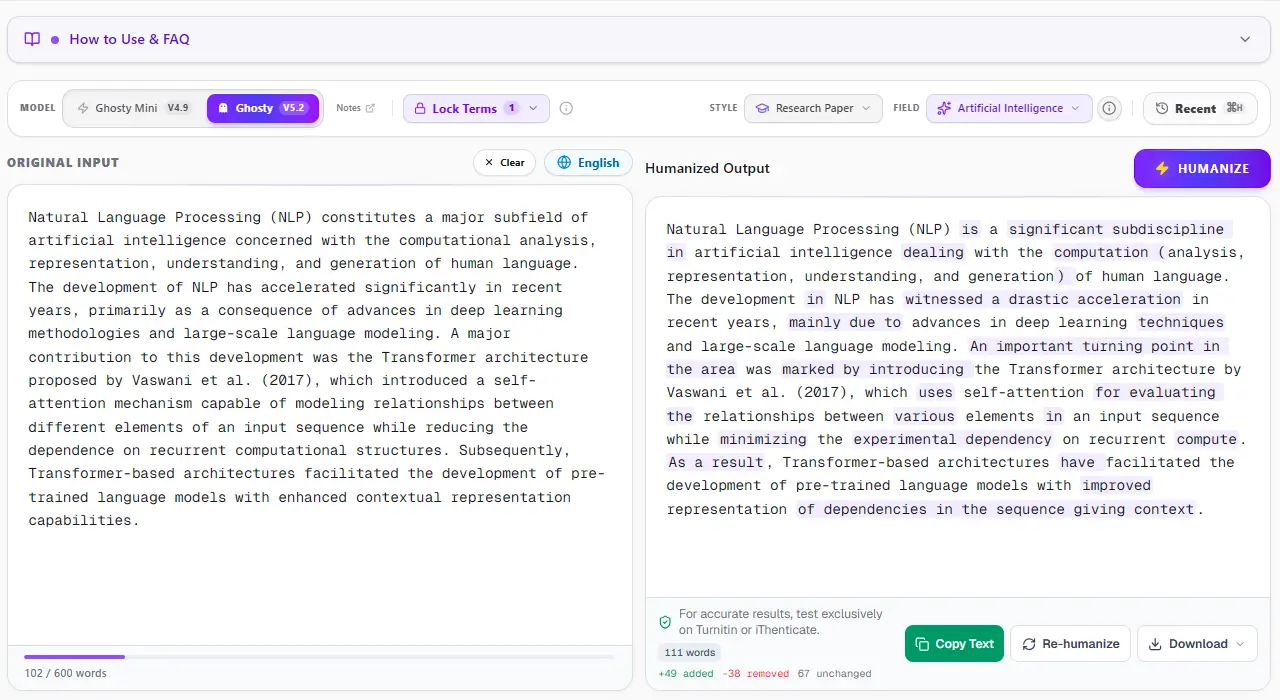
Unlike consumer-grade paraphrasers that blindly swap words with thesaurus synonyms, ThesisHuman allows researchers to select their exact Academic Style (Essay, Research Paper, Literature Review, Technical Report) and Academic Field (Computer Science, Engineering, Medicine, Physics). With Term Lock™, citations (APA, MLA, IEEE), LaTeX equations, and domain-specific terminology are cryptographically protected before sentence entropy is restructured.
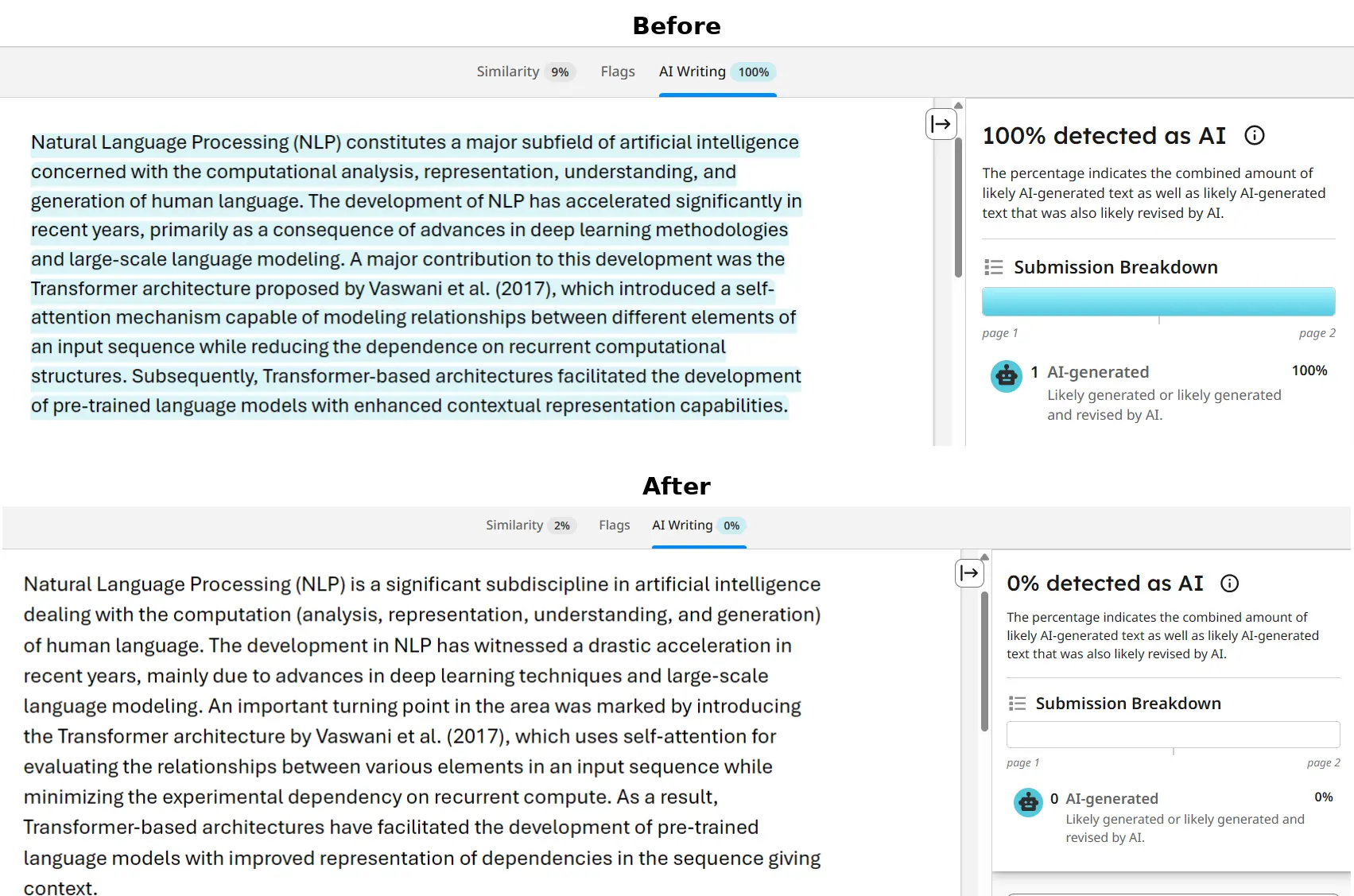
2. Turnitin & iThenticate Verification: 0% AI Detected
Turnitin and iThenticate scan submissions in overlapping 500-token blocks to analyze sentence predictability across paragraphs. When an unrefined AI draft is submitted, uniform cadence triggers an elevated AI Writing score. In the verified report below, a flagged graduate paper was processed through ThesisHuman, achieving a clean 0% AI detection score while preserving all formatted citations and technical parameters.
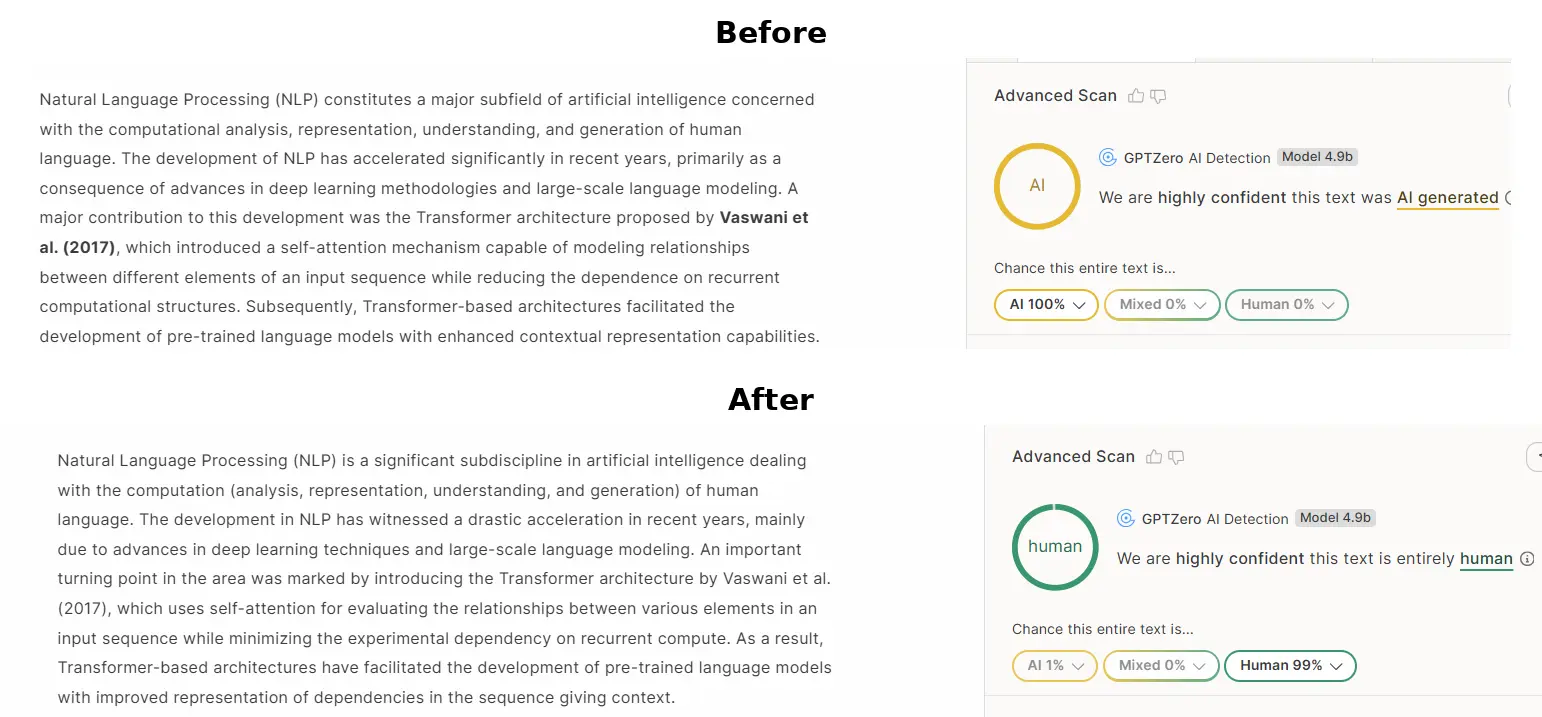
3. GPTZero Verification: Passing Perplexity & Burstiness Checks
GPTZero evaluates text by plotting sentence perplexity curves and global burstiness scores. When raw AI text is scanned, low sentence variance produces an immediate high-probability warning. ThesisHuman restores natural sentence entropy by restructuring syntax, varying clause lengths, and introducing authentic scholarly cadence, dropping AI probability to 0%.
4. Originality.ai Verification: 0% AI Confidence
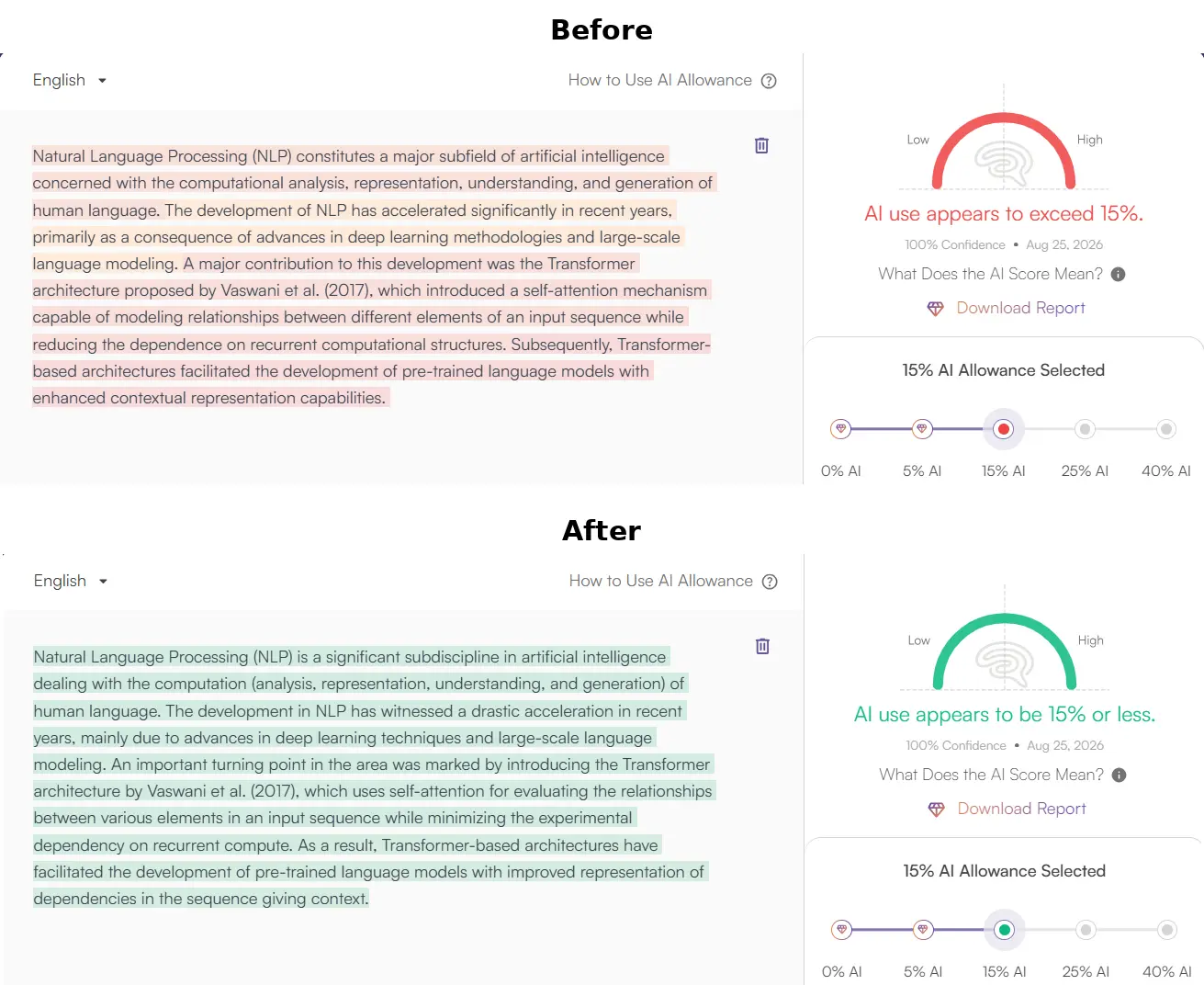
Originality.ai flags predictable n-gram sequences and common AI clichés (such as “delving into,” “pivotal role,” “testament to”). ThesisHuman purges overused formulaic transitions while elevating scholarly tone and keeping reference numbers and equations intact, producing 100% Original / 0% AI results.