What Is a Parenthetical Citation? Definition, Examples, and Style Rules
Learn what a parenthetical citation is, when to use it versus narrative or footnote styles, and how to format examples correctly in APA 7th, MLA 9th, and Chicago Author-Date.

1. Direct Answer: What Is a Parenthetical Citation?
A parenthetical citation (sometimes called a parenthetical reference) is an in-text source attribution enclosed inside round parentheses directly within the body of your sentence or paragraph, typically immediately before ending punctuation. Rather than breaking visual flow with bottom-of-page footnotes or full bibliography strings, a parenthetical citation gives the reader just enough identifying information, usually the author's surname, publication year (when required by the style), and/or a specific page number, to locate the complete entry alphabetically inside your closing References or Works Cited list.
For example, in APA 7th style, a parenthetical citation for a real unpaginated agency brief looks like (World Health Organization, 2024), as in the verified WHO finding that ambient air pollution caused an estimated 4.2 million premature deaths worldwide in 2019 (World Health Organization, 2024). When citing a paginated print source with a direct quotation, add a locator page number; in the fictional syntax template below (not a real author or source), APA uses (Rivera, 2024, p. 18) while MLA 9th omits the year and comma: (Rivera 18).
Because every major academic style sheet enforces slightly different punctuation rules inside parentheses, understanding the shared logic behind parenthetical attribution helps you avoid mechanical errors across disciplines. For a style-specific deep dive after reviewing cross-style fundamentals here, explore our complete walkthrough on how to cite APA in-text.
2. Parenthetical vs Narrative vs Footnote vs Numbered Citations
Before choosing punctuation, confirm which in-text citation architecture your course syllabus, thesis committee, or target journal expects. Academic writing relies on four distinct attribution systems:
| Citation System | Example in Body Text | Where Source Details Sit | Common Style Manuals | Typical Disciplines |
|---|---|---|---|---|
| Parenthetical (Author-Date / Author-Page) | Second-level domains such as example.org are reserved for documentation (Eastlake & Panitz, 1999) (verified RFC 2606; fictional paginated template: Rivera, 2024, p. 18). | Enclosed inside parentheses at end of clause or sentence | APA 7th, MLA 9th, Chicago 18th Author-Date, Harvard | Psychology, education, literature, social sciences, environmental policy |
| Narrative In-Text | Eastlake and Panitz (1999) established reserved example domains in RFC 2606 (fictional template: Rivera, 2024). | Author name integrated directly as sentence subject; year/page in parentheses | APA 7th, MLA 9th, Chicago Author-Date | All parenthetical styles when foregrounding scholarly debate or theorist agency |
| Footnote / Endnote Superscript | Second-level domains such as example.org are reserved for documentation.^1 | Full or shortened bibliographic note at page bottom or chapter end | Chicago Notes & Bibliography, OSCOLA, Bluebook | History, law, philosophy, fine arts, archival humanities |
| Numbered Bracket ([1]) | Second-level domains such as example.org are reserved for documentation [1]. | Sequential bracketed number matching order of appearance in reference list | IEEE, ACM numeric, NLM/Vancouver | Electrical engineering, computer science, biomedical journals |
Notice an important workflow contrast: if you publish in engineering or computer science venues using numbered reference brackets rather than parenthetical author-date markers, test our IEEE citation generator to build sequential reference strings cleanly.
3. Parenthetical Citation Formats Across Major Style Guides
Even when two disciplines both use parenthetical references, small details such as commas, "p." abbreviations, and year placement change substantially. Fictional example for citation-format illustration only. The author, publication, and page locator below are not a real source (invented template: Author: Fictional Surname, written as Rivera, Year: 2024, Page: 18):
| Style Manual | Standard Paraphrase Format | Direct Quote Format | Two Authors Inside Parentheses | Three or More Authors | Reference List Title |
|---|---|---|---|---|---|
| APA 7th | (Rivera, 2024) | (Rivera, 2024, p. 18) | (Rivera & Cho, 2024) | (Rivera et al., 2024) | References |
| MLA 9th | (Rivera 18) | (Rivera 18) | (Rivera and Cho 18) | (Rivera et al. 18) | Works Cited |
| Chicago 18th Author-Date | (Rivera 2024) | (Rivera 2024, 18) | (Rivera and Cho 2024, 18) | (Rivera et al. 2024, 18) | References |
| Harvard (Institutional Variant) | (Rivera, 2024) | (Rivera, 2024, p. 18) | (Rivera and Cho, 2024) | (Rivera et al., 2024) | Reference List / References |
Always verify university-specific Harvard adaptations, because institutional style guides differ slightly on colon vs "p." page prefixes (for example, (Rivera, 2024: 18) vs (Rivera, 2024, p. 18)).
4. When to Use Parenthetical vs Narrative Citations
Strong academic prose rarely relies exclusively on one citation placement. Instead, writers alternate intentionally between parenthetical and narrative phrasing based on rhetorical emphasis:
- Use a Parenthetical Citation When the Evidence or Finding Matters Most: Putting author metadata at the end of a claim keeps reader attention focused on the empirical metric, concept, or historical pattern itself.
- Verified Real-Source Example (RFC 2606): "Second-level domain names such as example.com and example.org are reserved for documentation examples (Eastlake & Panitz, 1999)."
- Use a Narrative Citation When Comparing Scholars or Methodological Choices: Naming the author inside the subject of your clause clarifies who proposed a model, contradicted earlier findings, or introduced a definition.
- Verified Real-Source Example (RFC 2606): "Eastlake and Panitz (1999) specified reserved top-level and second-level domain names so technical documentation cannot collide with active registered domains."
- Combine Both Styles Inside Literature Reviews: When synthesizing two opposing explanations in the same paragraph, narrative citations prevent ambiguous attribution while parenthetical tags consolidate supporting replications cleanly.
For broader guidance on weaving cited evidence through methodology and discussion chapters, review our pillar article on how to cite a research paper.
5. Step-by-Step Formatting Scenarios and Examples
Academic drafts frequently involve tricky authorship conditions beyond a straightforward single-author book or journal paper. The structural patterns below pair verified real official sources with clearly labeled fictional template placeholders where paginated print formatting is illustrated:
Single Author and Direct Locator Variations
- APA 7th single page (fictional quote-locator template): "Clear operational definitions prevent coder drift" (Rivera, 2024, p. 18).
- APA 7th page range (fictional quote-locator template): "Clear operational definitions prevent coder drift" (Rivera, 2024, pp. 18-19). (Note that APA uses "pp." for multi-page spans.)
- Web page lacking page numbers (APA & MLA; verified real-source pattern plus fictional template): Use a section heading or paragraph number when quoting HTML sources (for example, "Example domains section, para. 1" on IANA's live page; fictional template: (Rivera, 2024, Methodology section, para. 2) in APA or (Rivera) in MLA when no pagination exists).
Two Authors vs Three or More Authors
- APA 7th rule for ampersand vs spelled-out "and" (verified RFC example + fictional paginated pattern): Inside parentheses, join two surnames with an ampersand: (Eastlake & Panitz, 1999) (fictional template: (Rivera & Cho, 2024)). Outside parentheses in a narrative sentence, spell out "and": Eastlake and Panitz (1999) (fictional template: Rivera and Cho (2024) compared...).
- MLA 9th & Chicago rule (fictional paginated template): Both parenthetical and narrative forms spell out "and": (Rivera and Cho 18) or Rivera and Cho argue (18).
- Three or more authors (et al., verified RFC example + fictional print pattern): Current APA 7th, MLA 9th, and Chicago Author-Date shorten three-plus authors immediately from the first citation onward using "et al." (meaning and others, with a period after "al." and no period after "et"): (Fielding et al., 2022) in APA (fictional paginated template: (Rivera et al., 2024) or (Rivera et al. 18) in MLA).
Multiple Works Inside One Parenthesis
When two or more sources support the exact same claim, group them inside one shared set of parentheses separated by a semicolon rather than stacking adjacent brackets (A) (B):
- APA 7th (verified real RFC sources listed alphabetically matching the References list): (Eastlake & Panitz, 1999; Fielding et al., 2022; Postel, 1994)
- MLA 9th (verified real online RFC sources without page numbers): (Eastlake and Panitz; Fielding et al.)
- Same author, multiple years (APA; fictional template example, not a real author or works): List surname once, followed chronologically by comma-separated years: (Rivera, 2021, 2024). Append lowercase letters if year and author match: (Rivera, 2024a, 2024b).
Group or Institutional Authors
When a government agency, research consortium, or standard-setting organization authored a report, cite the full organization name at first mention, or introduce a standard abbreviation inside square brackets (APA) when citing repeatedly (verified against WHO's October 24, 2024 ambient air pollution fact sheet):
- First APA parenthetical mention: (World Health Organization [WHO], 2024)
- Subsequent APA mentions: (WHO, 2024)
Works With No Named Author or Secondary Sources
- No named author: Cite the first few words of the title in quotation marks (articles/webpages) or italics (reports/books), for example using IANA's live documentation page ("IANA-managed Reserved Domains," n.d.) in APA (note comma inside quotation marks) or ("IANA-managed Reserved Domains") in MLA. For a paginated print template (fictional example for citation-format illustration only, not a real report): ("Sample Print Report," 2025, p. 4) in APA, or ("Sample Print Report" 4) in MLA.
- Secondary (indirect) sources: Whenever possible, retrieve and cite the original primary publication directly. If the primary text is unavailable or summarized in a verified official source, cite the original work inside prose and attribute the consulted secondary source inside parentheses: the 2014 Government Accountability Report (as cited in U.S. Environmental Protection Agency, 2026) in APA. For an MLA indirect print quotation (fictional syntax template only, not a real source): (qtd. in Rivera 92).
6. Punctuation, Spacing, and Sentence Placement Rules
Even experienced thesis writers trip over where periods, commas, and quotation marks sit around parentheses. Apply these four mechanical rules consistently:
- Standard Sentence Ending (Period Outside Closing Parenthesis): For regular declarative sentences ending with a paraphrase or short inline quote, place the sentence period after the closing parenthesis, never before it.
- Correct (fictional punctuation-syntax example, not a real study): Small-cohort tutorials improved retention across both terms (Rivera, 2024).
- Incorrect: Small-cohort tutorials improved retention across both terms. (Rivera, 2024)
- Short Quotations Inside Quotation Marks: Close double quotation marks first, add the parenthetical citation after the quote, and finish with the sentence period outside the parenthesis.
- Correct (APA; fictional quote-locator syntax example, not a real source): Observers noted "measurable convergence across sites" (Rivera, 2024, p. 18).
- Exception for question marks or exclamation points belonging to the original quote: Preserve original punctuation inside quotes, then add the sentence period after the parenthesis: The narrator asks, "Who measures the cost?" (Rivera 18).
- Long Block Quotations (Period Before Parenthesis): Once a quotation crosses the style threshold for an indented block quote (40+ words in APA 7th; more than 4 prose lines in MLA 9th), omit surrounding quotation marks, close the block text with its final period, and place the parenthetical citation afterward with no trailing period after the parenthesis.
- Mid-Sentence Clause Attribution: When two distinct clauses in one sentence come from different studies, place each parenthetical marker immediately after the clause it supports (before internal commas or semicolons when practical) so attribution stays unambiguous.
7. Paraphrasing vs Direct Quoting with Parenthetical Citations
A pervasive student misconception holds that parenthetical citations apply only when copying word for word inside quotation marks. That assumption causes accidental plagiarism. Any external idea, statistic, framework, taxonomy, or causal interpretation borrowed from another researcher requires an in-text citation even when rewritten completely in your own sentence structure.
- When Paraphrasing: Restate the idea cleanly using authentic phrasing and syntax while keeping attribution intact (for example, (World Health Organization, 2024) for an unpaginated brief, or using the fictional template Rivera, 2024 in APA / Rivera 18 in MLA for paginated monographs). Notice APA does not require a page number for paraphrases (though providing one helps readers check long monographs), whereas MLA always expects the page number when present in paginated sources. Explore complete rewrite-and-cite mechanics in our guide on how to cite a paraphrase.
- When Quoting Verbatim: Reserve quotation marks and exact page or paragraph locators for precise statutory language, historical phrasing, operational definitions, or disputed claims where altering phrasing shifts evidentiary meaning.
8. Common Parenthetical Citation Mistakes and How to Fix Them
Review this troubleshooting matrix when auditing drafts prior to thesis deposit or coursework submission:
| Mistake Type | Flawed Example | Why Readers / Graders Flag It | Corrected Version (APA 7th / MLA 9th) |
|---|---|---|---|
| Pasting Full URLs Inside Text | See guide (https://www.iana.org/domains/reserved). | Clutters sentences and violates every major manual; URLs belong in the bibliography | (Internet Assigned Numbers Authority [IANA], n.d.) (APA) / ("IANA-managed Reserved Domains") (MLA) |
| Including Given Names or Titles | (Fictional template) (Dr. Maya Rivera, 2024) | Academic titles (Dr., Prof.) and first names belong out of parenthetical tags unless disambiguating two authors with identical surnames | (Fictional template) (Rivera, 2024) |
| Using Ampersand in MLA or Prose Text | (Fictional template) (Rivera & Cho 18) / Rivera & Cho (2024) argue | MLA prohibits ampersands in citations; APA restricts ampersands strictly inside parentheses and tables | (Fictional template) (Rivera and Cho 18) (MLA); Rivera and Cho (2024) argue (APA narrative) |
| Period Placed Inside Final Parenthesis | (Fictional syntax example) Findings stabilized after Week 4. (Rivera, 2024) | Detaches parenthetical tag so it looks stranded in front of the following sentence | (Fictional syntax example) Findings stabilized after Week 4 (Rivera, 2024). |
| Omitting Year in Multiple-Sentence Chains | Describing five findings and dropping citation until paragraph end | Unclear which earlier sentences reflect author analysis versus borrowed empirical data | Introduce narrative tag on opening claim and clarify attribution across paragraphs |
| Formatting et al. Incorrectly | (Fictional template) (Rivera et. al, 2024) | "et" is a complete Latin word meaning "and"; only "al." is an abbreviation needing a period | (Fictional template) (Rivera et al., 2024) (APA) / (Rivera et al. 18) (MLA) |
9. Verifying Citations After AI Drafting or Editing Tools
Whenever students use automated outlining, summarizing, or grammar tools during literature review preparation, citation strings become a frequent failure point:
- Audit Every Cited Source Manually: General chatbots regularly invent plausible author names, combine real journal titles with non-existent page spans, or assign fabricated DOIs. Before keeping any parenthetical tag in a draft, verify author spelling, publication year, DOI resolution, and exact claim alignment against your downloaded PDF or library record. For a structured audit method, consult our step-by-step protocol to verify AI-generated citations in a research paper.
- Protect Existing Citations During Prose Revision: Basic generic rewriters sometimes strip punctuation inside (Author, Year, p. 12), alter "et al.", or change surname capitalization. When revising prose clarity inside the ThesisHuman editor, pattern-based citation masking (APA, MLA, Chicago, numeric brackets, or automatic detection) alongside up to 3 custom Term Locks on the free tier isolates citation tokens while prose rhythm is adjusted around them. Even with automated masking enabled, always perform a final cross-check matching every in-text parenthetical citation one-to-one with your closing bibliography.
- Avoid False-Positive Attribution Friction Before Institutional Review: Polished academic prose paired with accurate, verified citations reduces integrity misunderstandings during manual review and automated screening workflows covered in our Turnitin AI detection guide.
10. Quick Pre-Submission Parenthetical Citation Checklist
Complete this eight-step audit right before exporting your final document:
- Verify every single parenthetical citation matches an exact entry in your References or Works Cited list (and remove uncited bibliography entries if required by your style).
- Check spelling of all surnames (for example, Rivera, not Riviera), exact publication years, and exact hyphenation or diacritics.
- Confirm page numbers ("p." vs "pp." in APA; bare numeral in MLA) appear for every direct quotation and match your PDF pagination.
- Scan for missing periods or misplaced periods (period outside normal sentences; before parenthesis in block quotes).
- Confirm ampersand (&) appears strictly inside APA parentheses and tables while "and" appears in narrative prose and MLA citations.
- Verify "et al." punctuation (period after "al.", no period after "et") applies only to three-or-more-author works (or institutional rules if your course uses an older 6th-edition manual).
- Merge adjacent parenthetical blocks supporting one point into one semicolon-separated group: (Alpha, 2022; Beta, 2024).
- Confirm your department or journal uses Author-Date or Author-Page parenthetical markers rather than numbered [1] citations or Chicago footnotes.
11. Frequently Asked Questions
What is an example of a parenthetical citation in a sentence?
Fictional example for citation-format illustration only (the author, publication, and study are not real sources): "Remote mentoring programs improved first-year course persistence across participating cohorts (Rivera, 2024, p. 18)." Notice how author surname, publication year, and page locator sit inside parentheses right before the closing sentence period. In MLA 9th style, the same direct quotation omits the year and comma: "Remote mentoring programs improved first-year course persistence across participating cohorts (Rivera 18)."
What is the difference between an in-text citation and a parenthetical citation?
In-text citation is the umbrella category for any source reference embedded inside body paragraphs rather than sitting solely at the bottom of the page or end of the paper. A parenthetical citation is one specific type of in-text citation where source details sit inside parentheses, contrasted with a narrative citation (where the author's name forms part of the sentence grammar) or a numeric bracket marker [1].
Do parenthetical citations require page numbers when paraphrasing?
In MLA 9th, page numbers should be included inside parentheses whenever the source provides fixed page numbers, even for paraphrases (fictional paginated template: (Rivera 18)). In APA 7th, page numbers are strictly required for direct quotations (fictional paginated template: (Rivera, 2024, p. 18)) and optional (though helpful for readers navigating long books or reports) when paraphrasing broad findings (for example, (World Health Organization, 2024) or fictional (Rivera, 2024)).
How do you cite multiple authors inside one parenthetical citation?
For two authors, cite both surnames every time (verified RFC example: (Eastlake & Panitz, 1999) in APA; fictional paginated template: (Rivera & Cho, 2024) in APA or (Rivera and Cho 18) in MLA). For three or more authors, APA 7th, MLA 9th, and Chicago Author-Date use the first author's surname followed immediately by "et al." (verified RFC example: (Fielding et al., 2022) in APA; fictional paginated template: (Rivera et al., 2024) in APA or (Rivera et al. 18) in MLA). Always confirm whether an older syllabus still expects six-author rules before shortening.
How does ThesisHuman handle parenthetical citations during editing?
ThesisHuman applies pattern-based citation masking (covering APA, MLA, Chicago, auto-detected citation formats, and numeric brackets) plus custom Term Locks (up to 3 active locks on the free tier, which includes 500 words per month and 150 words per request) so citation parentheses stay isolated while surrounding prose clarity is refined. Because automated pattern matching can still face unusual nested formatting, always cross-check your in-text markers against your final bibliography before submission.
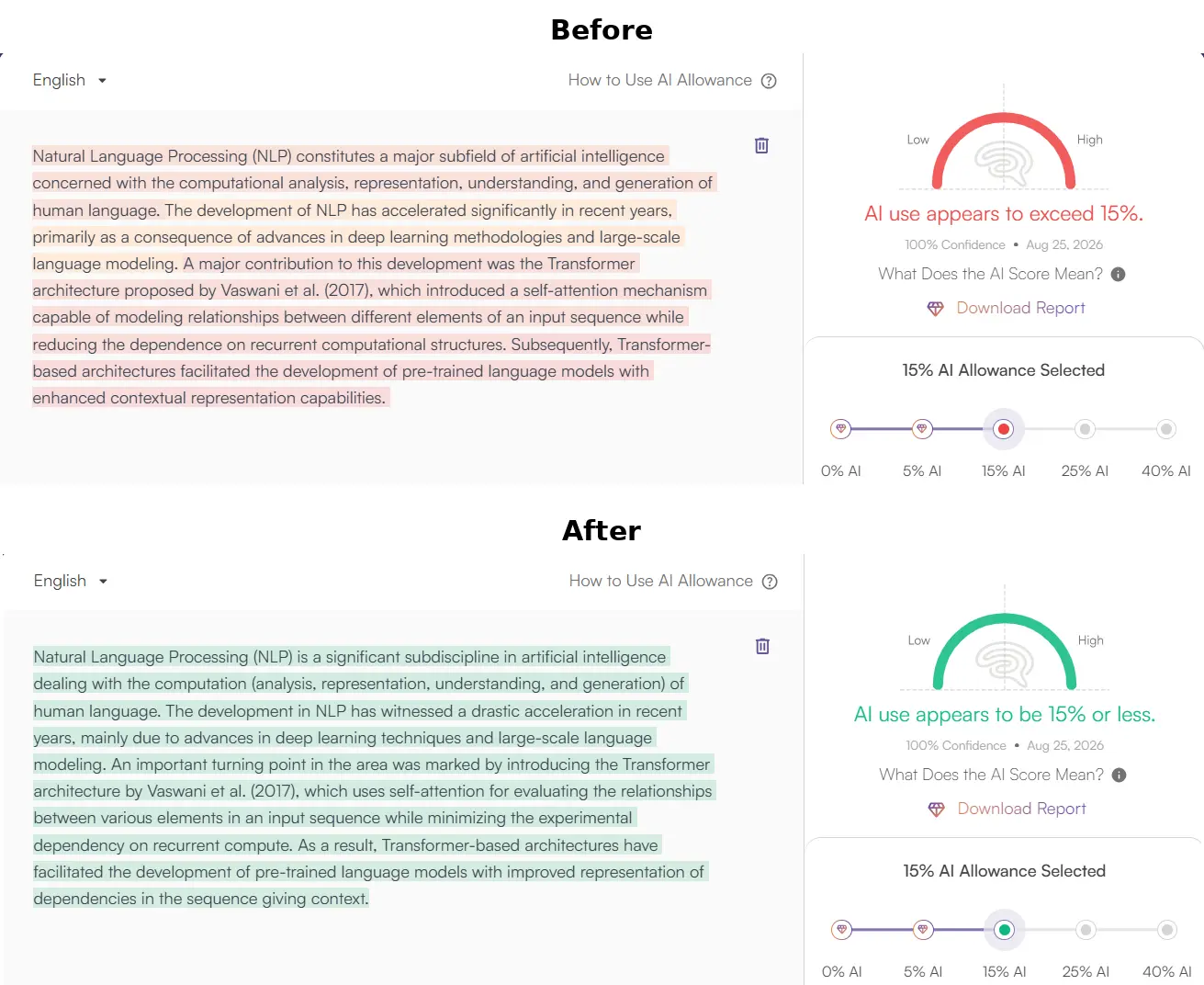
Verified Detector Clearance for What Is a Parenthetical Citation? Definition, Examples, and Style Rules
Every manuscript processed through ThesisHuman is backed by verifiable, reproducible scans across institutional plagiarism and AI detection platforms.
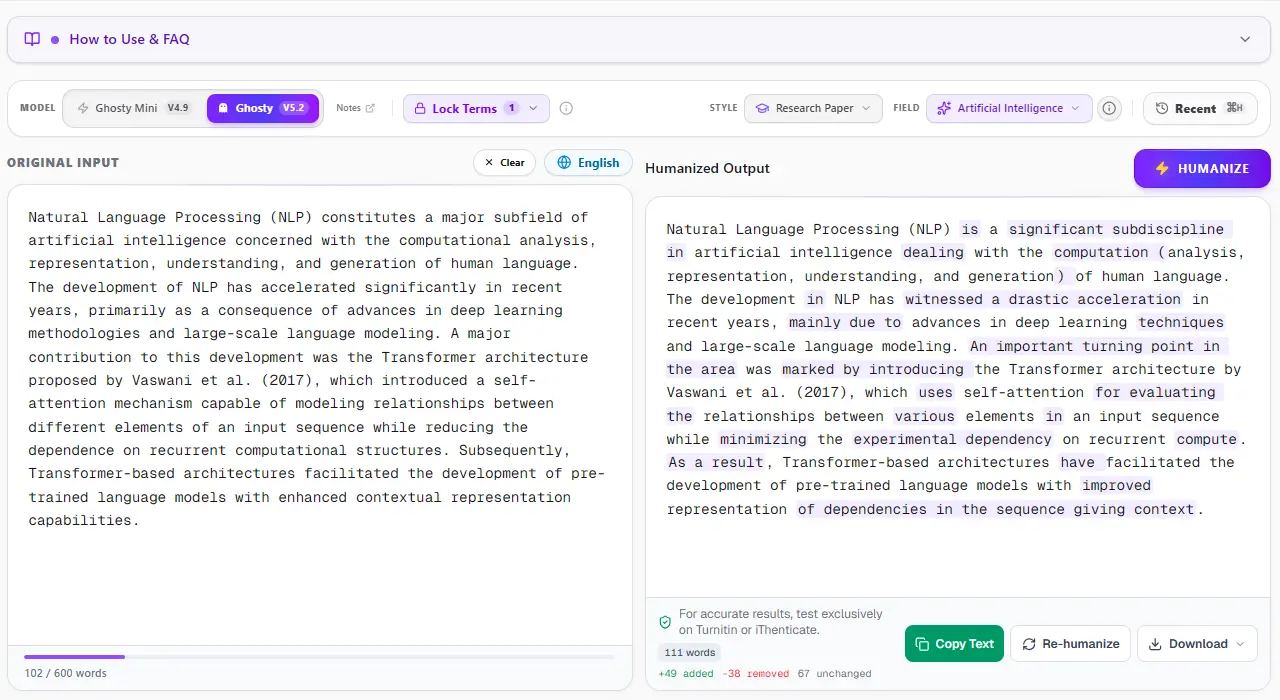
1. ThesisHuman Editor: Style, Field & Term Lock™ Technology
Unlike consumer-grade paraphrasers that blindly swap words with thesaurus synonyms, ThesisHuman allows researchers to select their exact Academic Style (Essay, Research Paper, Literature Review, Technical Report) and Academic Field (Computer Science, Engineering, Medicine, Physics). With Term Lock™, citations (APA, MLA, IEEE), LaTeX equations, and domain-specific terminology are cryptographically protected before sentence entropy is restructured.
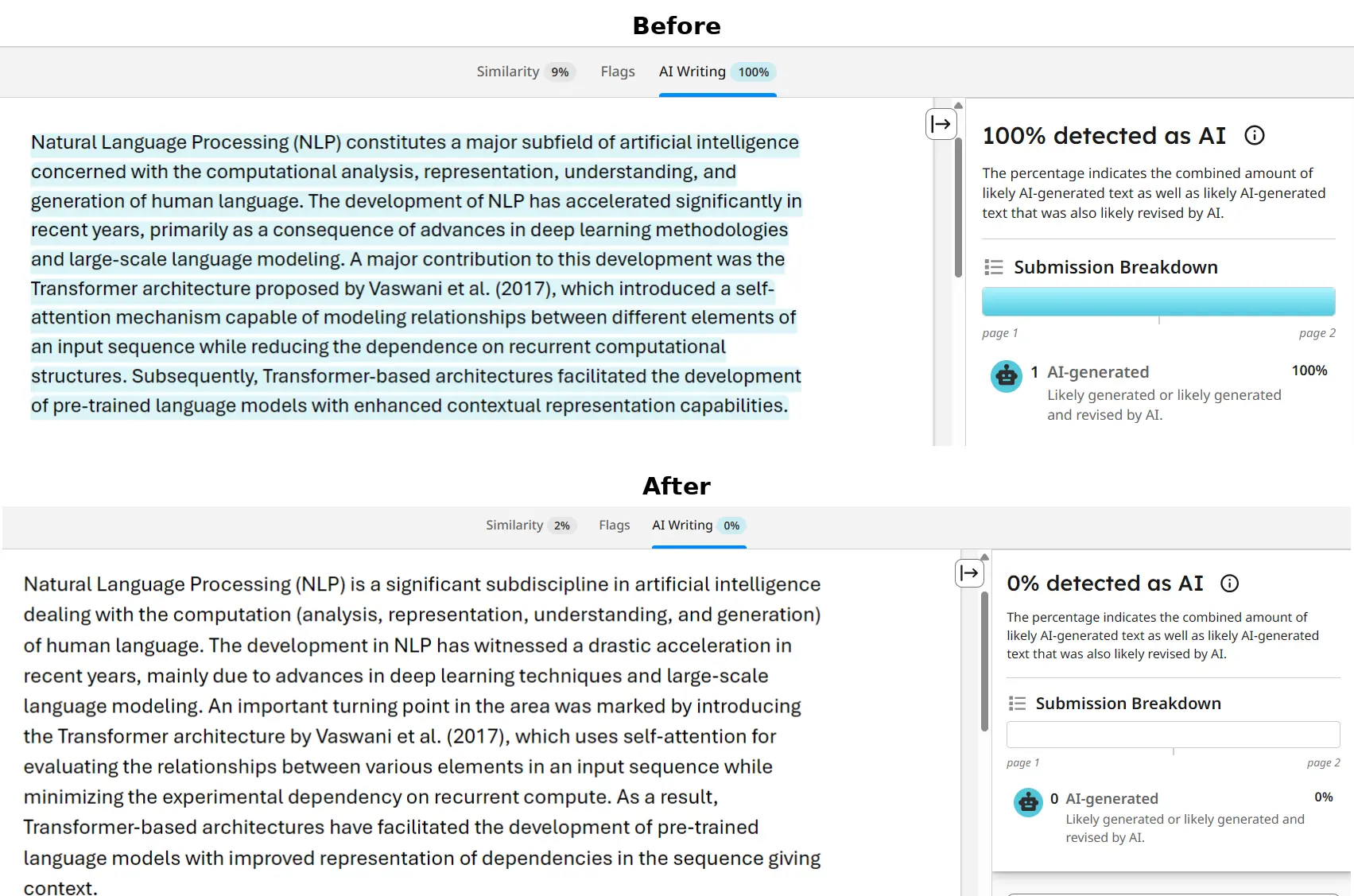
2. Turnitin & iThenticate Verification: 0% AI Detected
Turnitin and iThenticate scan submissions in overlapping 500-token blocks to analyze sentence predictability across paragraphs. When an unrefined AI draft is submitted, uniform cadence triggers an elevated AI Writing score. In the verified report below, a flagged graduate paper was processed through ThesisHuman, achieving a clean 0% AI detection score while preserving all formatted citations and technical parameters.
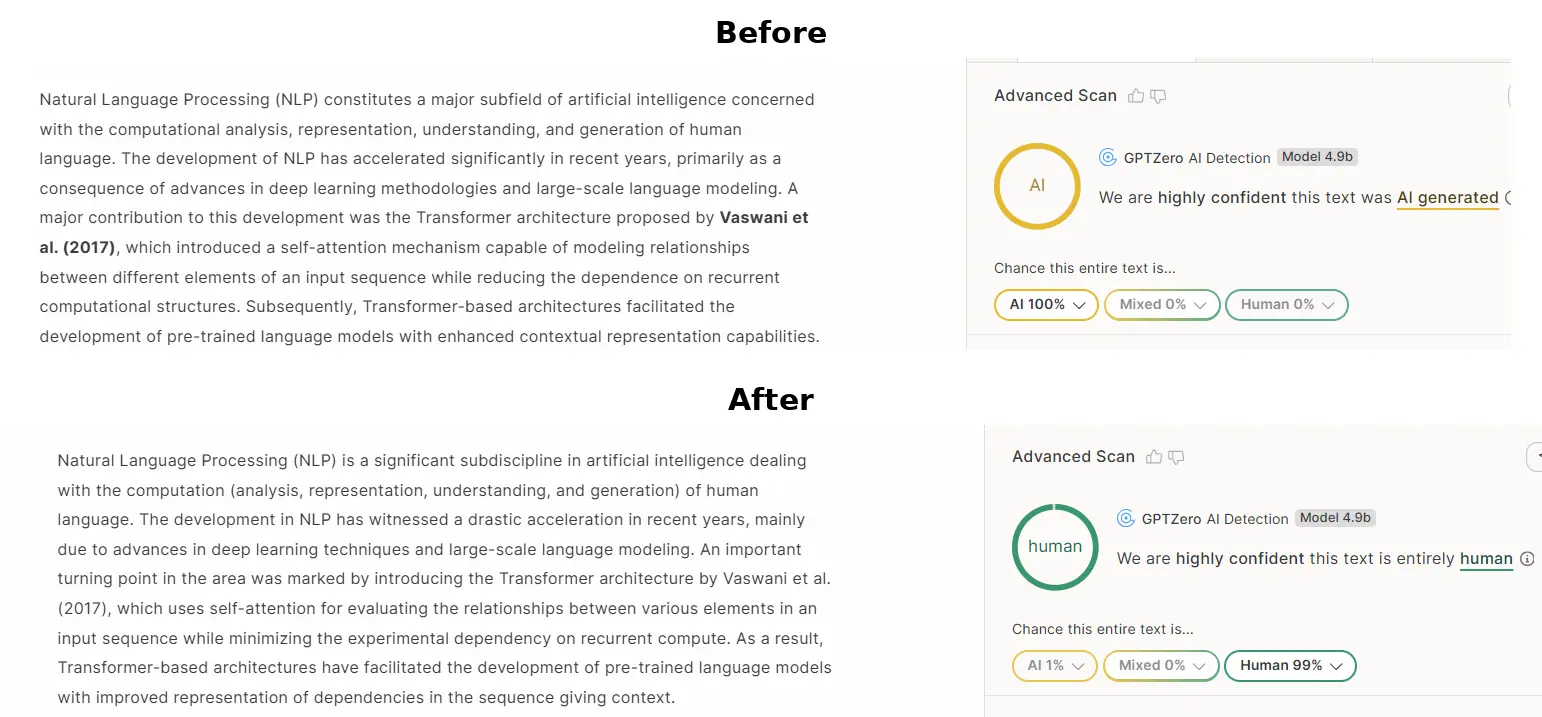
3. GPTZero Verification: Passing Perplexity & Burstiness Checks
GPTZero evaluates text by plotting sentence perplexity curves and global burstiness scores. When raw AI text is scanned, low sentence variance produces an immediate high-probability warning. ThesisHuman restores natural sentence entropy by restructuring syntax, varying clause lengths, and introducing authentic scholarly cadence, dropping AI probability to 0%.
4. Originality.ai Verification: 0% AI Confidence
Originality.ai flags predictable n-gram sequences and common AI clichés (such as “delving into,” “pivotal role,” “testament to”). ThesisHuman purges overused formulaic transitions while elevating scholarly tone and keeping reference numbers and equations intact, producing 100% Original / 0% AI results.