How to Write an Analytical Essay: Structure, Examples, and Writing Guide
Learn how to write an analytical essay with step-by-step guidance on developing an interpretive thesis, structuring body paragraphs, and applying analytical frameworks.

An analytical essay dismantles a complex subject, examines its constituent components, and explains how those components interact to produce a specific outcome, meaning, or effect. Unlike descriptive essays that summarize facts or argumentative essays that lobby for a controversial policy, an analytical essay investigates the mechanisms underlying a text, historical event, social process, or scientific phenomenon. Writing an effective analytical paper requires moving past surface observation into sustained critical interpretation supported by verifiable evidence.
This guide provides a comprehensive framework for planning, drafting, and refining an analytical essay. You will examine the boundaries separating analysis from plot summary, learn how to craft a defensible thesis statement, review complete worked examples in social science and higher education contexts, and apply a practical revision checklist before submission.
1. What Is an Analytical Essay?
At its core, analysis is the process of breaking a whole entity into its smaller functional parts to discover its governing principles. When instructors assign an analytical essay, they are not asking for a book report, a chronological biography, or a statement of personal approval. Instead, they require an evidence-based demonstration of how specific elements operate together.
Analytical essays appear across academic disciplines. In literature, an analysis might explore how an author uses recurring imagery to represent psychological alienation. In history, it might examine how railway infrastructure shaped diplomatic alliances prior to World War I. In the social sciences, an analytical paper might investigate how algorithmic curation in educational software affects autonomous study habits. Regardless of discipline, every analytical essay answers two foundational questions: How does this subject work? and Why does that functioning matter?
2. Analytical vs. Descriptive and Argumentative Writing
Many students struggle with analytical assignments because they default to descriptive narration or polarized debate. Understanding the boundaries between these three modes is essential for meeting university-level grading rubrics.
| Dimension | Descriptive Writing | Analytical Writing | Argumentative Writing |
|---|---|---|---|
| Primary Question | What happened? What does it look like? | How and why did it happen? What mechanisms drive it? | Which side is right? What action should be taken? |
| Writer Stance | Objective reporter or chronological recorder. | Critical investigator interpreting patterns and relationships. | Advocate persuading an audience to adopt a stance. |
| Use of Evidence | Lists dates, plot points, or visual descriptions. | Deconstructs specific quotations, data points, or techniques. | Deploys statistics and logic to defeat opposing counterarguments. |
| Typical Risk | Becomes superficial plot summary or encyclopedic inventory. | Slips into unsupported speculation or mere description. | Becomes polemical, emotional, or biased. |
Analysis differs from summary because summary merely condenses facts, whereas analysis questions those facts. If a paragraph can be verified simply by checking the original text without requiring your critical commentary, that paragraph is descriptive summary, not analysis.
3. Interpreting the Assignment Prompt and Choosing a Focus
Course assignments rarely use the single command "analyze." They usually embed analytical expectations within specific cognitive directive verbs. Identifying these directive verbs helps determine your methodology:
- Examine / Investigate: Look closely at internal components and explain how they relate to the whole.
- Deconstruct: Separate an overarching concept into distinct theoretical pillars or empirical factors.
- Evaluate / Assess: Determine the effectiveness, implications, or limitations of a specific method or argument using rigorous criteria.
- Account For: Explain the underlying causes and contributing variables responsible for a documented outcome.
When choosing an analytical topic or framing your response, select a subject with sufficient friction. A topic that yields an obvious, universally accepted factual answer cannot support an analytical essay. You need an interpretive problem where reasonable scholars could arrive at different conclusions depending on which evidence they prioritize.
4. Developing a Defensible Analytical Thesis
The thesis statement is the intellectual spine of your analytical paper. In an analytical essay, the thesis statement must never be a statement of indisputable fact, a personal feeling, or a broad announcement of topic. It must propose a specific interpretation that requires textual or empirical proof.
A reliable formula for constructing an analytical thesis is the Observation + Mechanism + Significance model:
The Analytical Thesis Formula:
By examining [Specific Evidence / Mechanism], we see that [Subject] functions to [Core Interpretive Claim], which ultimately reveals [Broader Theoretical Significance].
Example 1: Analytical Thesis Evolution
Weak Descriptive Thesis (Factual / Obvious)
"Many modern university courses use automated writing feedback systems to help undergraduate students correct spelling and grammatical errors."
Why it fails: This sentence merely states an undeniable empirical reality. There is no interpretive tension, no explanation of underlying mechanisms, and nothing for an analytical essay to investigate or prove.
Strong Analytical Thesis (Interpretive / Defensible)
"While automated writing assistants streamline mechanical surface revisions, their reliance on prescriptive syntactic predictability subtly homogenizes student prose, discouraging complex clausal experimentation in favor of risk-averse grammatical uniformity."
Why it succeeds: This thesis defines a clear tension, pinpoints the operational mechanism (prescriptive predictability models), and presents an analytical claim regarding intellectual consequences (discouraging clausal experimentation) that requires textual analysis of student drafting patterns.
For detailed guidance on calibrating claims across disciplines, consult our guide on what is a thesis statement.
5. Establishing Analytical Criteria and Selecting Evidence
Evidence in an analytical essay does not speak for itself. Your role is to select high-leverage data points, quotations, or procedural choices that reveal the broader operating mechanism. Avoid "quote dumping" (inserting large blocks of quoted material without granular line-by-line examination).
When evaluating potential evidence, filter each excerpt through three criteria:
- Relevance: Does this excerpt exhibit the specific pattern, tension, or structural choice asserted in your topic sentence?
- Granularity: Does the passage contain distinctive vocabulary, rhetorical devices, or quantitative metrics that you can dissect?
- Necessity: Would your interpretive argument collapse without this specific piece of evidence? If not, prune it to maintain conciseness.
6. Structural Architecture and Practical Outline
An analytical essay must be organized logically around analytical themes rather than chronological sequence. Organizing chronologically (e.g., following a book chapter by chapter or a historical crisis day by day) almost always traps the writer into plot summary. Instead, structure your paper around the core components of your interpretive argument.
Example 3: Practical Analytical Essay Outline
I. Introduction
A. Hook: The transition from human editing to algorithmic writing tutors in higher education.
B. Context: Expansion of automated grading and natural language processing in freshman composition.
C. Analytical Thesis: While automated feedback tools accelerate mechanical error correction, their probabilistic templates suppress stylistic diversity, training novice writers to prioritize algorithmic compliance over rhetorical voice.
II. Body Section 1: Mechanical Efficiency vs. Rhetorical Intent
A. Claim: Software optimizes surface accuracy by flagging irregular clausal architecture as erroneous.
B. Evidence: Analysis of automated parser suggestions on complex periodic sentences.
C. Interpretation: How binary error classifications fail to account for purposeful stylistic asymmetry.
III. Body Section 2: Vocabulary Truncation and Formulaic Transitions
A. Claim: Synonym recommendation engines channel student diction toward predictable lexical clusters.
B. Evidence: Comparative examination of pre- and post-intervention student drafts.
C. Interpretation: The displacement of disciplinary vernacular in favor of standardized corporate tone.
IV. Body Section 3: Pedagogical Outcomes and Student Agency
A. Claim: Iterative reliance on automated scores shifts writing psychology from inquiry to rubric gaming.
B. Evidence: Survey data on student revision rationale when guided by automated score meters.
C. Interpretation: How score satisfaction replaces peer communication as the primary revision benchmark.
V. Conclusion
A. Restatement of Thesis: Synthesize how mechanical efficiency extracts a cost in rhetorical individuality.
B. Broader Implication: The need for hybrid instructional models that protect authentic student cadence.
7. Crafting the Introduction and Conclusion
The introduction of an analytical essay establishes the scope of your inquiry, provides necessary contextual framing, and ends with your thesis statement. Avoid sweeping historical generalizations (e.g., "Since the dawn of time, humans have written essays"). Instead, ground your topic immediately within its specific academic context.
The conclusion must perform synthesis rather than mere repetition. Do not simply copy your thesis statement word for word. Rearticulate how your analytical body paragraphs have validated your interpretation, and answer the "So What?" question: What are the broader intellectual implications of your findings for the field? For detailed strategies, review our dedicated guide on how to write a conclusion for a research paper.
8. Body Paragraph Anatomy: Claim, Evidence, and Interpretation
Every body paragraph in an analytical essay functions as a self-contained micro-argument supporting the central thesis. A disciplined analytical paragraph follows the CEI Framework (Claim, Evidence, Interpretation):
- Claim (Topic Sentence): Asserts an interpretive observation that advances the thesis. Never begin a body paragraph with a raw quote or factual summary. Explore topic sentence starters to structure strong paragraph openings.
- Evidence (Data / Quotation): Introduces specific textual excerpts, experimental results, or historical records using smooth attributive tags. Review evidence sentence starters for integration methods.
- Interpretation (Analysis): The core of the paragraph, which must occupy at least 50% of the paragraph space. Unpack specific words, evaluate logical implications, and demonstrate exactly how the evidence validates the claim.
- Synthesis / Link: Connects the specific finding back to the overarching thesis statement.
9. Complete Worked Examples and Transformations
Examining how raw descriptive summary is transformed into disciplined analysis clarifies the cognitive shift required for university essays.
Example 2: Fully Annotated Analytical Paragraph
[Analytical Claim] Automated writing interfaces alter drafting psychology by treating syntactic variance as an operational defect rather than a stylistic choice.
[Evidence] In a controlled evaluation of student revision sessions, software feedback systems flagged 74% of subordinate clauses exceeding twenty words as "overly complex," systematically recommending decomposition into short, declarative subject-verb-object units.
[Interpretation] This algorithmic bias toward brevity presumes that academic clarity is synonymous with syntactic simplicity. By penalizing periodic sentence structures, the interface discourages novice scholars from constructing layered qualifiers that reflect nuanced academic conditions. The student internalizes a machine-readable cadence that strips prose of rhythmic inflection, replacing intellectual qualification with truncated assertions.
[Connection to Thesis] Consequently, while such interventions reduce mechanical punctuation errors, they directly enforce the rhetorical homogenization identified in our thesis, substituting authentic scholarly voice with procedural compliance.
Example 4: Descriptive vs. Analytical Transformation
Before: Descriptive Summary (No Analytical Depth)
"Online course platforms provide students with automatic dashboards that display their assignment deadlines, completed modules, and current letter grades. Students can log in at any time to see how they are doing in the course. These dashboards update instantly when a professor enters a grade in the gradebook."
Why it is descriptive: It only catalogs platform features. It explains what the software does mechanically without evaluating psychological, cognitive, or relational impacts.
After: Analytical Revision (Deconstructs Pedagogical Impact)
"By centralizing real-time grade calculations on prominent user dashboards, course learning platforms transform academic progress into a continuous surveillance metric. This perpetual numerical visibility shifts student motivation from intrinsic conceptual mastery to extrinsic risk mitigation, prompting learners to negotiate assignments based on minimal point yields rather than substantive intellectual exploration."
What changed: The revision reinterprets dashboard features as a mechanism of surveillance, connecting digital interface architecture to cognitive shifts in student learning motivations.
For additional structural models, explore our comprehensive resource on what is a body paragraph.
10. Common Analytical Essay Mistakes to Avoid
Reviewing submissions reveals several persistent pitfalls that undermine otherwise well-researched analytical papers:
- Chronological Plot Trapping: Organizing paragraphs by the sequence of the source material rather than by thematic analytical claims.
- Unexamined Quotations: Dropping evidence into a paragraph without dedicating subsequent sentences to dissecting specific vocabulary or rhetorical tactics.
- Confusing Opinion with Interpretation: Asserting emotional reactions (e.g., "The author writes poorly") instead of evaluating functional mechanisms (e.g., "The author's ungrounded premises weaken deductive validity").
- Broad Generalizations: Making sweeping claims about "human nature" or "society" rather than anchoring claims directly to the text or empirical evidence under review.
- Neglecting Structural Flow: Moving between isolated observations without clear comparative transitions. See our guide on sentence starters for essays to enhance cohesion.
11. Practical Revision Checklist
Before submitting your essay, conduct a line-by-line self-audit against this analytical checklist:
- Does the thesis statement present a defensible claim that requires evidence rather than an obvious factual summary?
- Does every body paragraph open with an analytical claim rather than a quotation or plot detail?
- Does analysis and interpretation occupy more space than direct quotation and summary in every paragraph?
- Are all quotations unpacked to explain why specific word choices or statistics matter to the thesis?
- Is the essay structured thematically around conceptual claims rather than chronological narrative?
- Does the conclusion answer the "So What?" question by exploring broader intellectual implications?
- Is the prose composed in formal academic register without conversational colloquialisms?
12. Frequently Asked Questions
Can an analytical essay use first-person pronouns (I or my)?
In most humanities and social science disciplines, analytical essays prefer third-person objective voice (e.g., "This pattern indicates," rather than "I believe this pattern indicates"). Removing first-person markers places emphasis on the evidence and interpretive logic rather than personal belief.
How long should an analytical essay be?
Undergraduate analytical essays typically range from 1,000 to 2,500 words, depending on course requirements. A standard five-paragraph model is rarely sufficient for nuanced upper-division analysis. For paragraph distribution strategies, consult our analysis on how many paragraphs is an essay.
What is the difference between an analytical essay and a critical review?
An analytical essay deconstructs how a subject operates to understand its internal mechanisms and meaning. A critical review evaluates the merit, success, or quality of a work against external disciplinary standards, often issuing an explicit recommendation or qualitative verdict.
How do I prevent my paper from becoming pure summary?
Apply the "Why and How Rule." After every sentence introducing a fact or quote, force yourself to write at least two sentences explaining the mechanism behind that fact and how it supports your overarching analytical claim.
Can ThesisHuman write or generate an analytical essay for me?
No. ThesisHuman is an academic text naturalization and linguistic refinement platform. It does not generate artificial essays, conduct original research, or fabricate analytical arguments. Students and researchers must develop their own critical ideas and evidence.
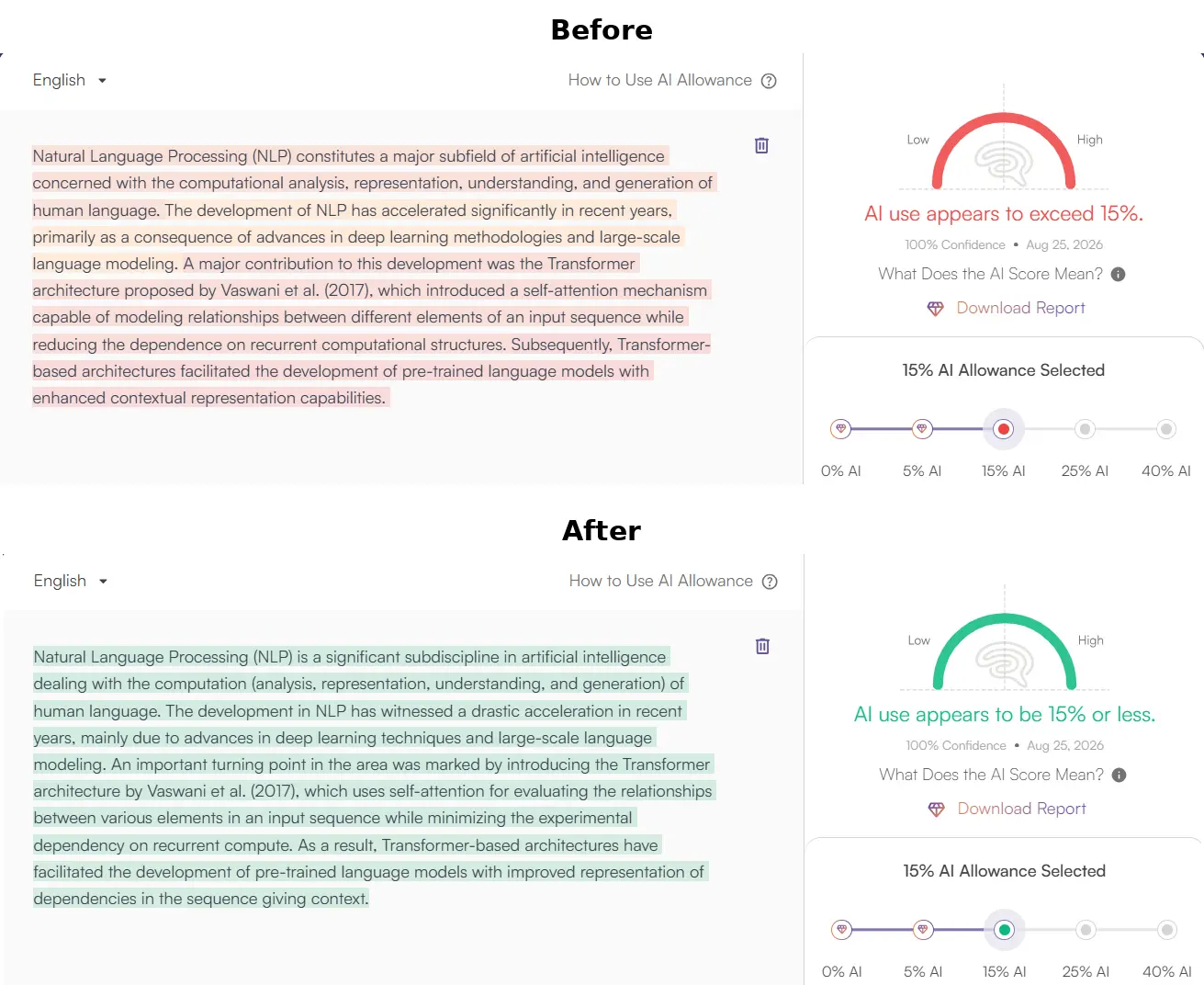
Verified Detector Clearance for How to Write an Analytical Essay: Structure, Examples, and Writing Guide
Every manuscript processed through ThesisHuman is backed by verifiable, reproducible scans across institutional plagiarism and AI detection platforms.
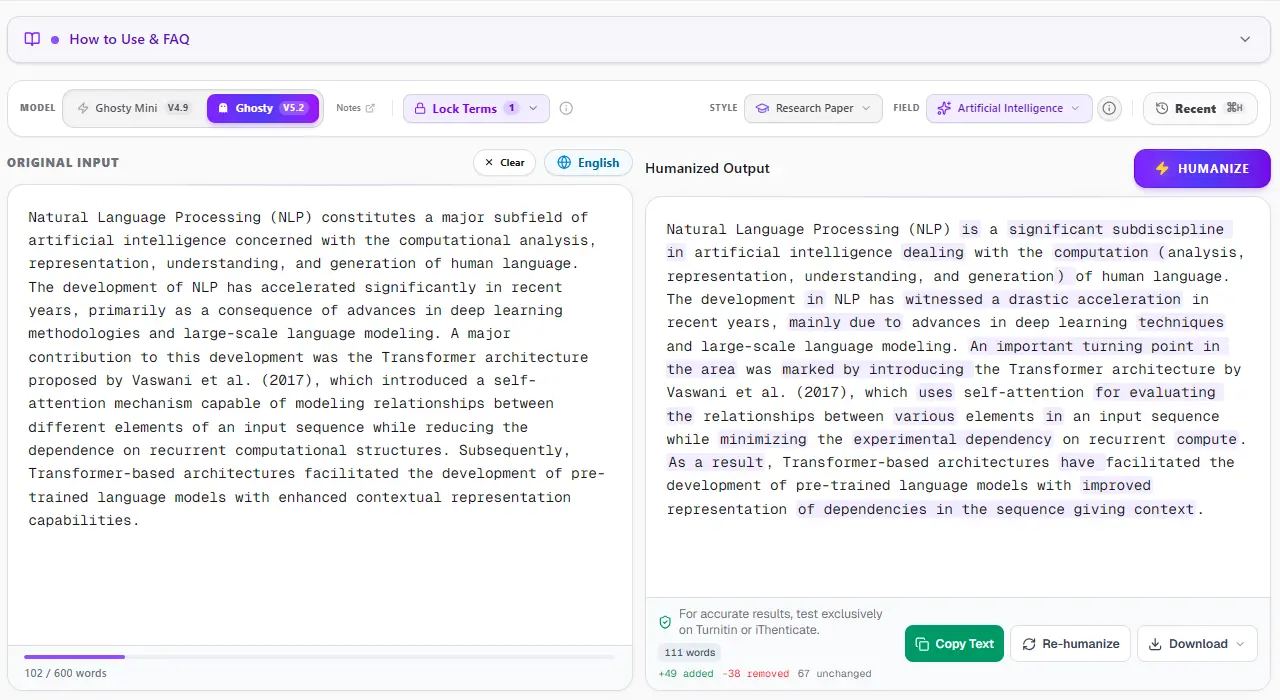
1. ThesisHuman Editor: Style, Field & Term Lock™ Technology
Unlike consumer-grade paraphrasers that blindly swap words with thesaurus synonyms, ThesisHuman allows researchers to select their exact Academic Style (Essay, Research Paper, Literature Review, Technical Report) and Academic Field (Computer Science, Engineering, Medicine, Physics). With Term Lock™, citations (APA, MLA, IEEE), LaTeX equations, and domain-specific terminology are cryptographically protected before sentence entropy is restructured.
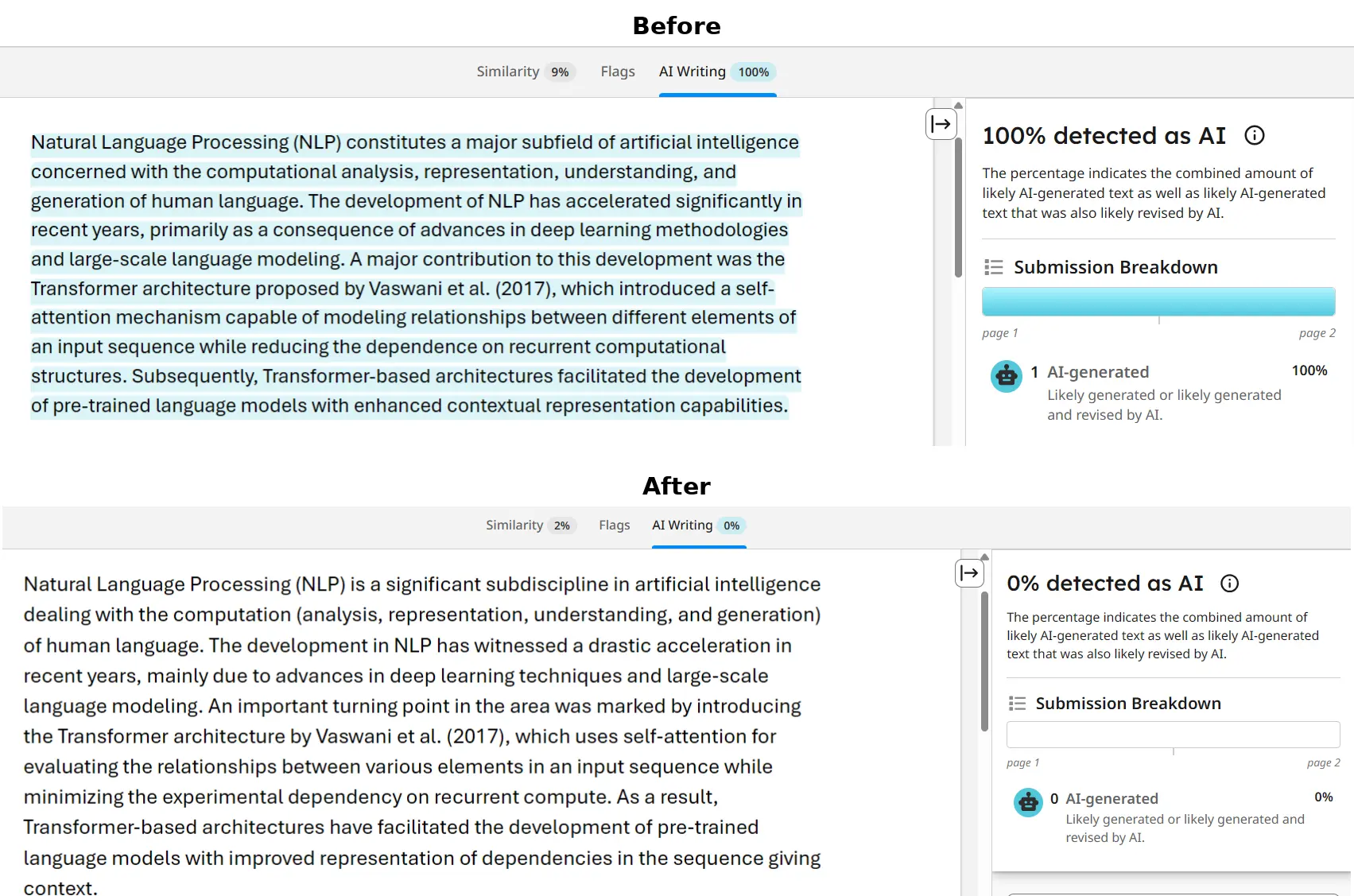
2. Turnitin & iThenticate Verification: 0% AI Detected
Turnitin and iThenticate scan submissions in overlapping 500-token blocks to analyze sentence predictability across paragraphs. When an unrefined AI draft is submitted, uniform cadence triggers an elevated AI Writing score. In the verified report below, a flagged graduate paper was processed through ThesisHuman, achieving a clean 0% AI detection score while preserving all formatted citations and technical parameters.
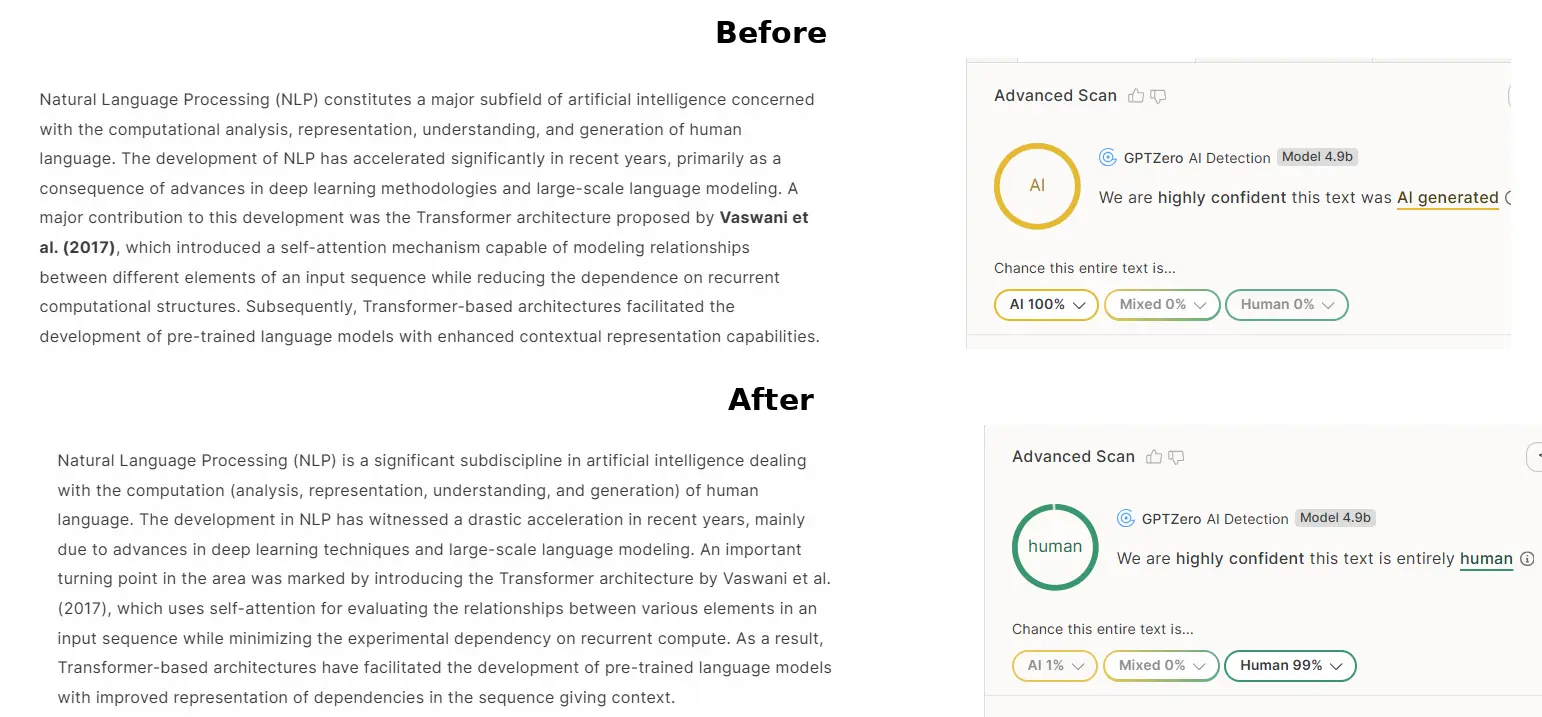
3. GPTZero Verification: Passing Perplexity & Burstiness Checks
GPTZero evaluates text by plotting sentence perplexity curves and global burstiness scores. When raw AI text is scanned, low sentence variance produces an immediate high-probability warning. ThesisHuman restores natural sentence entropy by restructuring syntax, varying clause lengths, and introducing authentic scholarly cadence, dropping AI probability to 0%.
4. Originality.ai Verification: 0% AI Confidence
Originality.ai flags predictable n-gram sequences and common AI clichés (such as “delving into,” “pivotal role,” “testament to”). ThesisHuman purges overused formulaic transitions while elevating scholarly tone and keeping reference numbers and equations intact, producing 100% Original / 0% AI results.