University AI Policies in 2026-2027: A Student Compliance Guide
Understand current university rules on artificial intelligence: permitted language polishing versus unauthorized generation, mandatory disclosure wording, and graduate school deposit standards.

Universities entering the 2026 to 2027 academic year have largely updated their guidelines regarding generative artificial intelligence. Initial blanket prohibitions have been replaced by structured institutional policies covering disclosure, student accountability, and research ethics.
Understanding these guidelines is important whether you are preparing coursework, a master's thesis, or a doctoral dissertation. Failing to follow institutional requirements can lead to committee reviews, delayed graduations, or grading penalties. This guide reviews common policy models and provides a student compliance checklist.
The Transition from Bans to Disclosure
Institutions including Columbia Law School (which implemented an updated AI policy effective August 1, 2026) approach assistive AI similarly to third-party editing or proofreading. Common institutional guidelines across Oxford, Cambridge, and major research bodies reflect three basic principles:
- Author Accountability: The author takes full responsibility for all calculations, empirical claims, and citations in the document. Blaming software for incorrect claims is considered negligence.
- No Unauthorized Generation: Using software to formulate core arguments, generate hypotheses, or fabricate data without instructor authorization is prohibited.
- Permitted Language Refinement: Using software to correct grammar, improve clarity, or adjust sentence rhythm is generally permitted when declared according to course or faculty instructions.
Three Common Tiers of Institutional AI Policy
Many academic syllabi for the 2026 to 2027 cycle group AI usage into three categories:
| Category | Typical Activities | General Policy Status |
|---|---|---|
| Tier 1: Language and Editing Assistance | Grammar correction, sentence flow editing, reference formatting | Widely permitted; standard disclosure recommended |
| Tier 2: Research and Exploratory Tasks | Brainstorming questions, code debugging, summarizing sources | Permitted with methodological disclosure |
| Tier 3: Prohibited Misconduct | Unedited text generation, unapproved use in exams, fabricated findings | Prohibited; subject to formal review |
Writing an Academic AI Disclosure Statement
When a department or target journal requires an acknowledgment statement, use a clear, standard declaration. Place it in your methodology section, footnotes, or an acknowledgments appendix:
"During manuscript preparation, the author(s) used [Tool Name, e.g., ThesisHuman] for language editing and sentence-level refinement. All empirical analyses, citations, and conclusions were independently conducted and verified by the author(s), who take full responsibility for the content."
For additional discussion on ethical submissions, consult our article on How to Pass Turnitin Originality Checks Ethically.
Specific Requirements for Theses and Dissertations
Graduate schools apply careful review to electronic thesis and dissertation deposits. When preparing a thesis for repository archiving:
- Consult Your Advisor Early: Confirm in writing with your supervisory committee that your planned editing workflow complies with department guidelines before scheduling your defense.
- Review iThenticate Standards: Many graduate offices run final submissions through iThenticate. Check our guide on iThenticate AI Detection for Researchers for details on how the system evaluates manuscripts.
- Verify Data Privacy: Confirm that your editing tools do not retain or train on your text. Avoid uploading confidential lab data or unpublished findings to tools with unclear data policies.
The Pre-Submission Compliance Checklist
Before submitting a major manuscript this term:
- Check the specific AI statement in your syllabus or program handbook.
- Confirm all cited articles in academic databases using our citation verification protocol.
- Confirm that mathematical equations and citation keys remain intact with LaTeX-safe editing methods.
- Archive your drafting history in Overleaf, Word, or Google Docs.
- Review your final paper against The AI-Assisted Research Paper Pre-Submission Checklist.
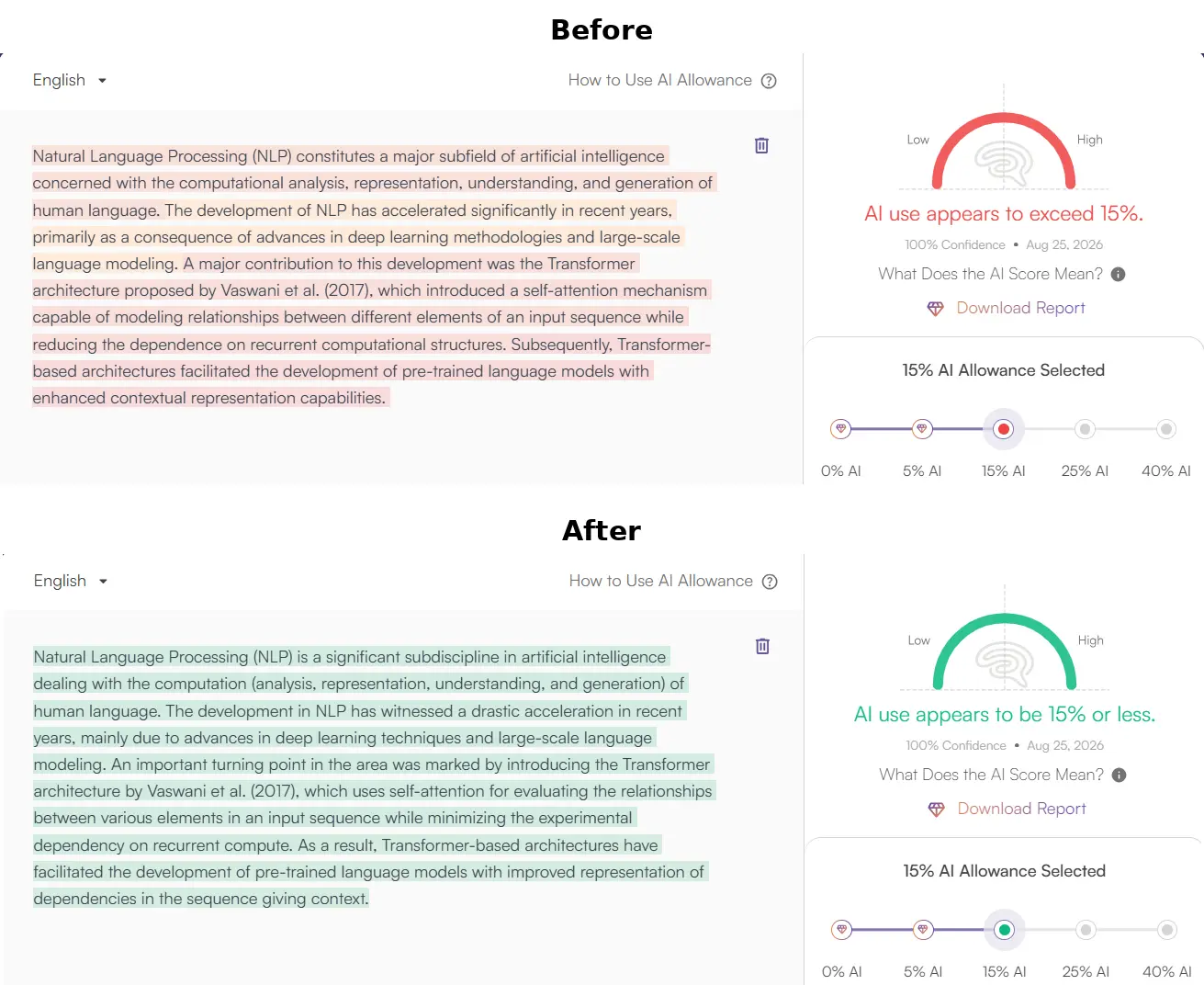
Verified Detector Clearance for University AI Policies in 2026-2027: A Student Compliance Guide
Every manuscript processed through ThesisHuman is backed by verifiable, reproducible scans across institutional plagiarism and AI detection platforms.
1. ThesisHuman Editor: Style, Field & Term Lock™ Technology
Unlike consumer-grade paraphrasers that blindly swap words with thesaurus synonyms, ThesisHuman allows researchers to select their exact Academic Style (Essay, Research Paper, Literature Review, Technical Report) and Academic Field (Computer Science, Engineering, Medicine, Physics). With Term Lock™, citations (APA, MLA, IEEE), LaTeX equations, and domain-specific terminology are cryptographically protected before sentence entropy is restructured.
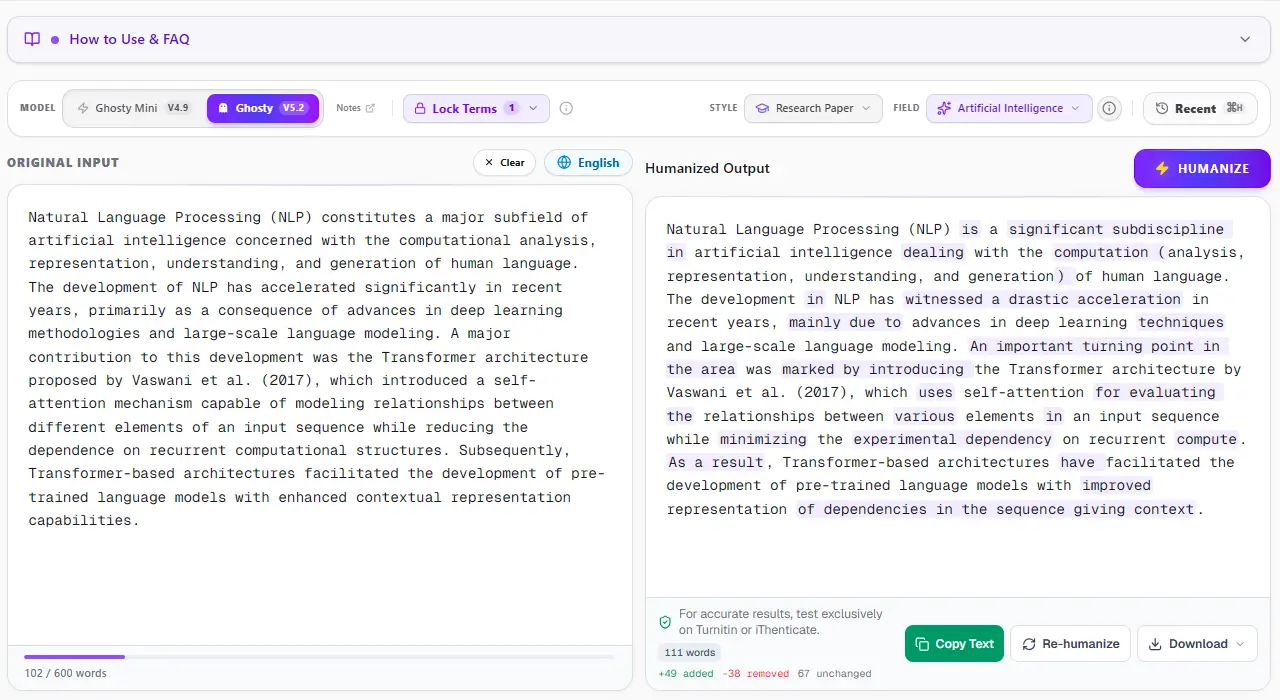
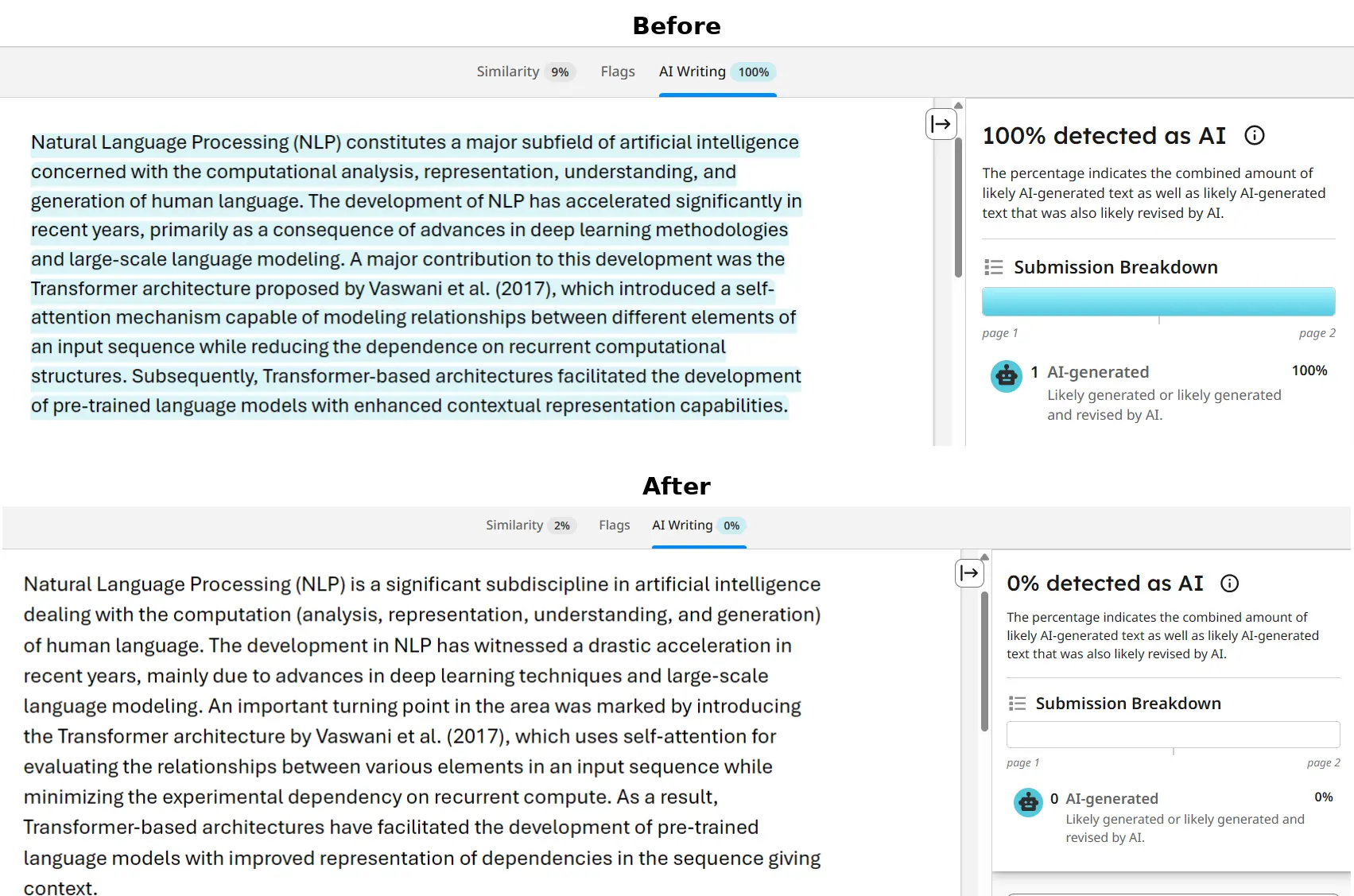
2. Turnitin & iThenticate Verification: 0% AI Detected
Turnitin and iThenticate scan submissions in overlapping 500-token blocks to analyze sentence predictability across paragraphs. When an unrefined AI draft is submitted, uniform cadence triggers an elevated AI Writing score. In the verified report below, a flagged graduate paper was processed through ThesisHuman, achieving a clean 0% AI detection score while preserving all formatted citations and technical parameters.
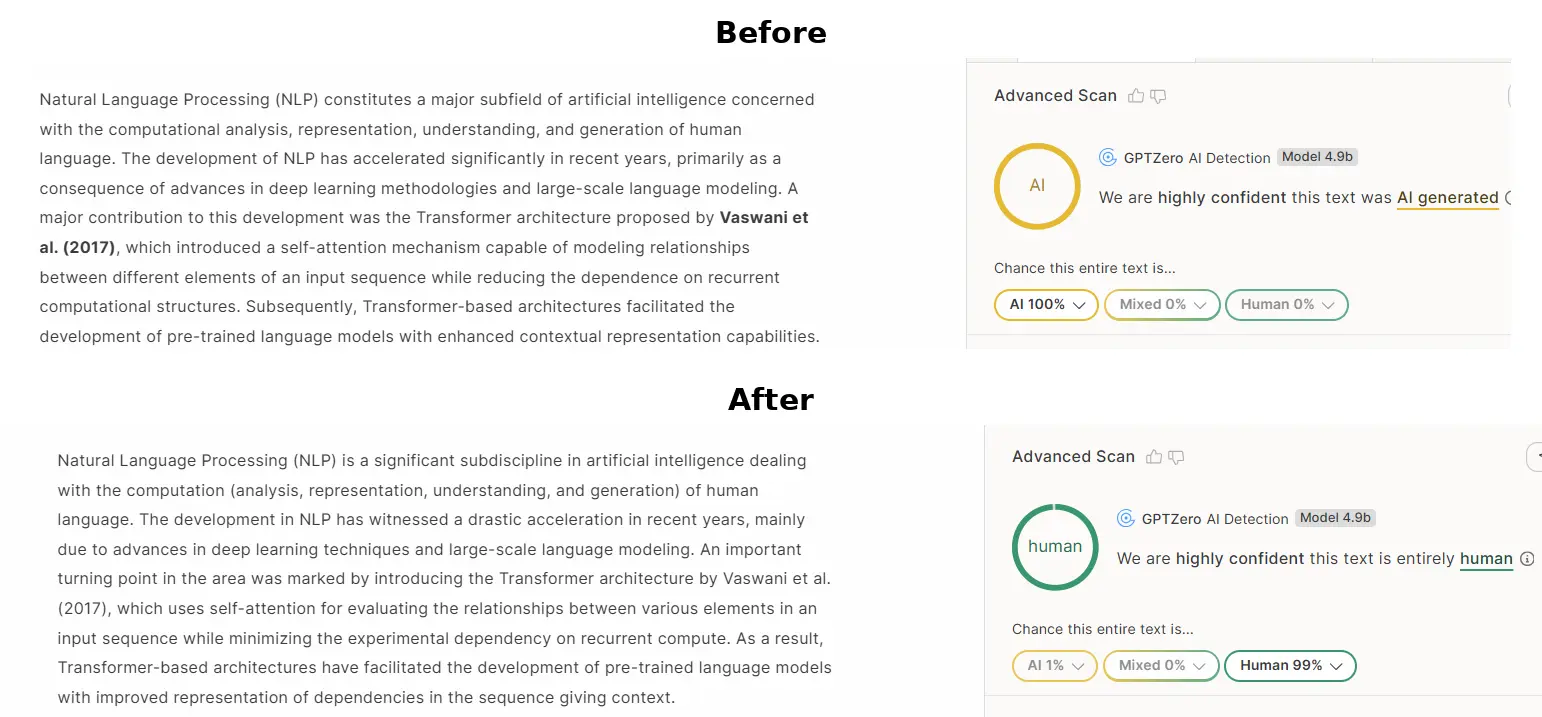
3. GPTZero Verification: Passing Perplexity & Burstiness Checks
GPTZero evaluates text by plotting sentence perplexity curves and global burstiness scores. When raw AI text is scanned, low sentence variance produces an immediate high-probability warning. ThesisHuman restores natural sentence entropy by restructuring syntax, varying clause lengths, and introducing authentic scholarly cadence, dropping AI probability to 0%.
4. Originality.ai Verification: 0% AI Confidence
Originality.ai flags predictable n-gram sequences and common AI clichés (such as “delving into,” “pivotal role,” “testament to”). ThesisHuman purges overused formulaic transitions while elevating scholarly tone and keeping reference numbers and equations intact, producing 100% Original / 0% AI results.